
Tourism in Bialowieza Forest to develop in the right way
Janusz KORBEL, Specially for the Website "Belovezhskaya Pushcha – 21st Century", October 28, 2006
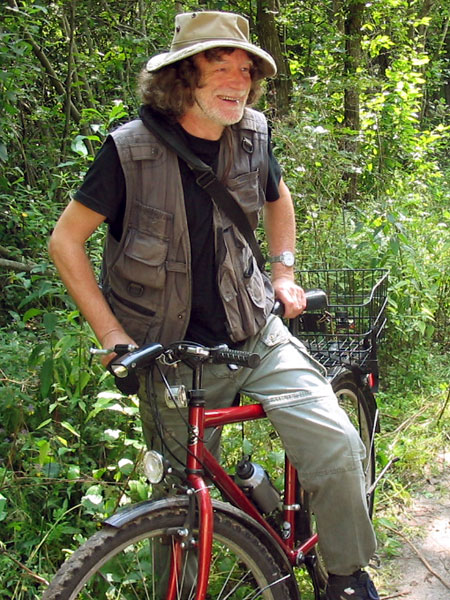
Janusz Korbel
An interview by Heorhi Kazulka [HK], coordinator of the "Belovezhskaya Pushcha – 21st Century" Project, with Janusz Korbel [JK] (Poland), regional activist for protection of Bialowieza Forest, member of the Public organization "Association for Landscape Protection" and one of the leaders of the "Bialowieza International Solidarity Network" Public Initiative, about problems and prospects of development of tourism and protection of Bialowieza Forest.
[HK] - Dear Janusz. Please tell briefly about a history of raising the public initiative of the last years to protect Bialowieza Forest.
[JK] – Regarding preservation of Bialowieza Forest, a campaign to protect the Forest was raised fourteen years ago and, fortunately, ended with extension of the area of the National Park in 1996. In March of this year, we initiated an international campaign called "Bison" (in Polish "Zhubr"). The name could seem some strange but this is because "bison" in English means the same as "Zhubr" in Polish. Such the name was chosen in connection with the international status of the campaign that to make it clear in English. It is also deciphered "Bialowieza International Solidarity Network". The word "Zhubr" was not well-appropriate since a famous Polish trade mark, including beer, vodka etc, is under the same name.

The map of Polish part
of Bialowieza Forest

The map of the district
center of Hajnowka
in Polish part of
Bialowieza Forest
A letter to the President Lech Kaczynski became the first step of the public campaign to protect the Forest, then it was supported by the international society. I have issued the book "Man and the Forest" half a year ago. The book has a small description of the history of a campaign to protect the Bialowieza Forest. We observed a very recent period featuring stagnation of protection of the Bialowieza Forest. For example, three and a half years ago, services of the State Forest's body illegally cut down 472 trees in stands of the age of over hundred years in the times when so-called "moratorium" on cutting down old-aged woods was still in force. On the base of this fact, I together with reporter Adam Wajrak have managed to raise a grandiose scandal. He has written a perfect article for a Warsaw's newspaper and added it with good pictures. The article described cutting down only seven trees but they were very large, aging over hundred years. Thanks to actions initiated by a team "Szczecinskaia Gaia" from the city of Szczecin, an office of public prosecutor instituted proceedings against the guilty persons. The investigation was rather complicated. The office of public prosecutor in Hajnowka made the first stage of the investigation but the proceedings were soon ceased. It's clear why. There is no matter to mention this as a public prosecutor together with the local foresters makes their common businesses here. The proceedings were then delivered to an office of public prosecutor of the Bialystok province. A court later confirmed a legal base for accusations put by the ecologists, in terms of illegal felling of trees. The infringers were punished with small penalty and proceedings were again ceased. Thus, poor-resulted disputes on protection of the Bialowieza Forest became the basic achievement for the last two years. Economic activity proceeded in Forest. Besides, bark beetles promoted cuttings to be continued for the recent years. The other, very bad events also took place in the area.
[HK] - What, in your opinion, is a primary factor which threatens preservation of the Bialowieza Forest?
[JK] – Forest management is only one of the factors which destroys nature of Bialowieza Forest. There are other factors including very dangerous ones. The last of such the dangerous events is a simplified border crossing from Poland to Belarus. This crossing was declared servicing pedestrians and bicyclists.
[HK] - Is this really the threat to the Bialowieza Forest? Why?
[JK] - Yes. To create this crossing, reconstruction of a road and building a terminal was necessary. For this purpose about one hectare of a wood area in the middle of the Polish Forest has been cut down. But if this simplified crossing services pedestrians and bicyclists, nothing grandiose like the above mentioned was necessary to build. The placing a small construction for the frontier employees, custom service and tourists' passport control was enough. All of these would normally function like it was done once, for example, on the border between Poland and Slovak or Czech Republic where the tourists can cross the border using tourist tracks. Few years ago we had small check points there (for example Balnica). This crossing doesn't exist now as we are a member of European Union.
Nevertheless, the border crossing like on other frontier roads was made in Bialowieza. This case allows making one signature of any governmental top-manager that to open car traffic here. On the other hand, creation of such the grandiose structure for crossing generates car traffic in itself. If even the crossing for cars does not yet exist, one needs to reach the crossing in any way. The people go to the crossing by cars, first of all through the Bialowieza forest. Very few people use bicycles. If the tourist flow will increase, building of new car parking areas and development of other services will be necessary. This is because the each who invests measures like this thinks, first of all, of development of the business, instead of its stagnation. So, the situation finally turns out that, instead of regulation of car traffic in the vicinity of the Bialowieza Forest, all lets things slide.
[HK] - How, in your opinion, should this tourist flow be regulated?
[JK] – The Bialowieza Forest is a vast wood massif and the most unpleasant what we can make against its preservation is to generate traffic at the core of this massif and to allow the maximum of flows through the centre of the Forest.
Instead of this, reasonable planning of tourism's development should be based on the idea that the centre of traffic regulation must be placed in the vicinity of the Bialowieza Forest, for example, in Hajnowka. This is the town. And appearance of factors, even dangerous for protection of nature, is not, therefore, the threat to the Forest. There is an appropriate infrastructure to serve tourists there. Thus, it is necessary to think of development of the entire region, not just the centre of the Bialowieza Forest.
[HK] – What are possibly actual measures to make this? What are the basic ideas?
[JK] – If to develop the areas around the villages of Narew and Narewka, tourist flows geographically, like beams, should be went from Hajnowka to all directions in the Bialowieza Forest. It's easy to reach Hajnowka by buses and trains. The tourists coming back could do shopping, as the goods are cheaper there. Exhibitions, festivals and other mass-people's actions are also possible to be organizing there.
If to talk about development of international tourism, in the case of possible kind relations with Belarus in the future (good-neighbourliness) which could also positively affect development of well-being in the Belarusian region, tourist flows should be regulated even earlier – in Polowce in the south of Forest and in Bobrowniki in the north. A normal transport infrastructure is available there. Firstly, there are things in these areas interesting for tourists as well. Secondly, for example, it would be very convenient to arrive from the Pushcha's south to the Belarusian village of Kamenyuki, avoiding crossing the Bialowieza Forest and going round its woodlands. This would promote its better conservation.
However, instead of it, the crossing at the centre of the Bialowieza Forest was actually made and traffic to Belarus is basically focused on seeing a Grandfather Frost. That is some kind of Disneyland arranged. I realized why it's so. Development of ecological tourism focused on the foreign visitors, generally speaking, is very poor on the Belarusian side. This is why a show called "Grandfather Frost" was made. It's easier to do this than to be engaged in ecological tourism and education.
[HK] - What arguments were used to ground necessary of the crossing at the centre of the Bialowieza Forest?
[JK] - For the purpose of construction of this crossing, Polish local authorities not so much used as speculated with the fact that, ostensibly, an old grandmother from the Bialowieza village can bicycle to a Belarusian cemetery where her husband's grave is placed or she will come to see the relatives in Belarus. You know that the people on both sides along the border have the same history, culture, traditions and ethnographic roots. The state border divided them as late as 60 years ago. Many of them have the relatives on the other side of the border. For last 40 - 50 years, contacts between them were very limiting. The people are few aware of each other. This is why the given arguments got achieved political victory.
A whole year has passed and it is already possible to sum up. Firstly, a question concerning visa's issues is not solved up to now. One can't but laugh that local inhabitants must go to the city of Bialystok to get a visa. However, an office arranging visas was later opened in the hotel "Zhubrowka" in the Bialowieza village. Nevertheless, no one of the inhabitant of the Hajnowka district can get the visa there.
[HK] - Why?
[JK] – The arguments are that visas for tourists, who come from other areas of Poland, live in the hotel, pay money and buy excursion to Grandfather Frost, should be given out of there. No one thinks of the local inhabitants. Thus, it is clear today that this was propaganda of the first water.
Such the restriction is used to hinder an opportunity of developing frontier trade dealing with vodka and cigarettes. But it was clear from the beginning because either border crossing serves development of this kind of business and trade. So, this fact also testifies about the big mistake regarding the opening such the crossing. It is not necessary to trade in vodka at the centre of the Bialowieza Forest, but to develop the pure ecological tourism. However, we will pay big price for this mistake in the future, after relations between the countries are to be improved and the flow of tourists is to be increased. The threat exists concerning possible serving cars at the given border crossing in the future, not only pedestrians and bicyclists. It will be very difficult to hold pressure of cars. We already know such historical examples as one things were under plans whereas the absolutely another was put into practice, for example in Czech regarding a railway crossing the frontier.
[HK] - Probably, development of tourism in Poland negatively affects nature and biological diversity of the protected wood. Isn't it?
[JK] – Yes, it is. Except for the above mentioned threat, there is other unpleasant thing which very quickly will destroy the primeval features of the region of Bialowieza Forest. This is a road infrastructure. Let me put only one example. The road from Hajnowka to Bialowieza crosses the Bialowieza forest. Three weeks ago, two wolves were lost under wheels of cars on this road within few days. It makes 10 percent, maybe even more, of the wolf's population in the Bialowieza Forest, since less than 20 wolves live there. Why have happened so? This is because Bialowieza becomes a centre of visiting by numerous tourists. Huge hotels for about 300 beds were built there. For example, the hotel "Zhubrowka" for about 360 beds is currently under reconstruction. It is clear that this kind of hotels can normally work in the case only when they are designed for mass visiting, not for individual tourists, for example to take part in conferences which can cover all expenses. For example, 10 buses with the participants of a conference will simultaneously arrive there from all over Europe. The people will stay there within three or four days. 60 light horse-carriages will come to the hotel for driving the tourists across Forest.
There is one more factor. An open glade for winter feeding of bison was still recently near Bialowieza. After the administration of the State Forests found a common language with the management of the hotel, buses and horse-carriages began to deliver tourists to this glade to participate in concerts. You can imagine how loud sound is there, if my friend from the village of Teremiski, that's 9 km from the glade, hears these concerts at the night. Wild animals also hear it. Moreover, salutes and fireworks are happened in the end of a holiday. Thus, today such kind of tourism is the most powerful factor, not only for development of the Bialowieza village. It is the most dangerous for wild nature of the Bialowieza Forest too.
Unfortunately, the local authorities want to develop tourism exactly in this way. A road to Narew and Narewka in the north part of the Forest was open few years ago. Now, at the late summer – early autumn, the road traffic is not intensive there. However, during long holidays or days off, first of all in May, very intensive flow of cars runs on this road, from Warsaw and somewhere else. Cars often carry bicycles above. Some tourists leave cars and further cycle damning the entire world. Imagine sand-dust, noise and just disturbance by motor vehicles. No pleasure.
Moreover, I am not optimistic regarding this road because, early or late, it will be asphalted. And it will then turn to a serious barrier for migrating animals including such big ones as wolves, roe deer, or hares. As for small ones like frogs, it will become insuperable in terms of blocking their migration's ways. If nothing will be changed in the concept of development of tourism and the Bialowieza village will remain its centre, this will provoke intensive car traffic on this road, since this is the shortest way to Bialowieza, despite crossing the Bialowieza Forest.
There is one more road called Silnicka which goes up to the tourist site Topilo where tourists are driven along a narrow-gauge railway. Silnicka Road is now closed for traffic, but not all: first few kilometers are easy of access for automobiles and a parking was made close to the tourist attraction, so called “Place of a Power” (within the framework of a DANCEE international project). Some days the foreign eco-tourists who already visited this area came to there. They were walking along the pass and, in the heart of the wood, met this large parking which was earlier absent. One can imagine their reaction after they see development of infrastructure in the core of the relic wood.
[HK] – What's regarding railways which were built in the Bialowieza Forest in the times of a Russian tsar and First World War?
[JK] - There are also plans to open a railway from Hajnowka to Bialowieza, making its functions by transferring into a private property. This is the very dangerous plan because it's easy to find the people who can realize the project. The arguments are used that the railway traffic is less danger for environment compared with cars. Logic is present here. However, after starting-up of transportation on the railway no one will close the road to Bialowieza and will stop car traffic on it. The case when people come to Hajnowka, leave cars there and further go by train will not happen. Thus, the railway will become an additional source of intensive flow of tourists to the centre of the Bialowieza Forest. Besides, the railway infrastructure will also stimulate development of private business like sales of beer, goods etc. This is not only superfluous pressure to nature, but also new barriers for migrations of animals.
The National Park pushed an idea to restore a narrow-gauge railway and to start the movement to the reserved site Gluszec and further to Old Bialowieza. It means they tried to make some kind of entertainment for tourists. Fortunately, this project has only remained atheory. I am a member of the Scientific Council of the National Park and we got success at a session of the Council last year to stop this proposal, although there was very difficult to do it. Nevertheless, such the intention did not yet disappear.
[HK] - What kind of obstacles do the roads create for wild animals?
[JK] - There is a road so-called Zwierzynecka, from Hajnowka directed to the villages of Budy and farther to Narewka. This road is today with an asphalt cover, even deep into Forest, and one can well drive by car. There could be put many examples like this. Of course, large roads such as from Hajnowka to Bialowieza generate the biggest damage to nature. They divide habitats of animals. The animals try to avoid roads. Even such mighty animals as bison unwillingly cross this road, basically at night. I witnessed these scenes myself when bison wanted to cross this road, but were afraid of doing it.
There is no matter to tell about huge amount of lost birds, first of all young innocent specimens which are training to fly. In the summer they fly close to a road because this is the open space allowing them to be easy navigating, while cars run very fast. And no one does anything in order to limit speed of traffic on this road, although it is just necessary to set a road sign limiting speed to 60 - 80 km / hour, instead of 100 km like now. No terrible will happen if a man will reach Bialowieza from Hajnowka 2 - 5 minutes later. The sign of speed restriction is not always effective for a driver. But at the outskirts of Hajnowka, near a cemetery, a policeman is often staying to catch the road-hogs. Why do not place him one kilometer far?
There is one more way, less repressive. It is enough to make so-called “sleeping policemen” in some places across the road. It would be also good to make positive advertising of these restrictions, such as "Tourist, you drive across the protected area, the animals are in danger so please move slowly". I am sure that 90 percent of the people would accept this argument. The majority of them come here to enjoy the one's stay, instead to destroy something.
At the same time the local authorities think about how to enlarge this road and to remove obstacles hindering big speed. This is the serious threat to the Bialowieza Forest. Not tourism, but human consciousness, first of all of the owners of the region forms this threat. Unfortunately, the fact is that the owners of this region are the opponents of nature protection to a maximum extent. As to the tourists, they do not represent the big threat. I am not a guide but having a permission sometimes I lead small groups of guests into the strictly protected zone of the National Park or have the meetings with the tourists groups in the hotels. Very often I hear dissatisfied remarks of the tourists about why you allow so many cars here, why there are no sheets indicating nature protection and forbidding entrance to the forest, why we come to listen to a voice of wild wood and songs of wild birds, but instead of these we hear noise of civilization, why entertaining events are held here, instead of other more distant places. Many tourists understand the way in what the forest nature must be protected.
[HK] - Are there any positive prospects in terms of improvement of the situation and solving the problems?
[JK] - In connection with the election of a new president, the situation has recently got chance to positive changes because the new people who are yet not in the net of corruption appeared. We now call the new authorities for best protection of the Bialowieza Forest. The international action of March 3 attended to address directly to the President as he represents interests of the society as a whole. We are not going to restrict ourselves by a single ecological action, and we try to repeat what were 10 - 15 years ago, when a powerful international campaign for preservation of the Bialowieza Forest was organized. The first was we made a letter addressed to the President Lech Kaczynski and signed by 4 people – biologist from Spain Nuria Selva Fernandez, anthropologist from USA Eunice Blavascunas, Belarusian singer Dzmiter Vaitiushkevicz – Todar (he often visits this area) and me. Then, in the frame of the Public Initiative "Bison", we initiated an international campaign and ask the President to take the problem of preservation of the Forest under his personal control.
3rd of March, 2006 became the Day of International Solidarity with Bialowieza Forest. Due to help of various international organizations, we have managed to carry out the worldwide campaign advertising the needs of help for the Bialowieza Forest. As a result, the President received about 10,000 letters from all over the world that brought a great effect in the President's Office. In the same day the people who wanted to better protect Forest picketed near Polish embassies in 22 countries around all continents. Many newspapers in the different countries wrote about this event. In the same day our delegation visited the President's office (ph.d. Nuria Selva Fernandez, Eunice Blavascunas, prof. Tomasz Wesolowski and Zenon Kruczynski). On March 4, Dzmiter Vaitiushkevicz and his group “W-Z Orchestra” have given a concert in Bialowieza to support the Forest. Video-frames about the international action to support the Bialowieza Forest (the pictures came via Internet from all over the world) havesimultaneously been demonstrating.
[HK] - What are the results of this worldwide appeal to the President?
[JK] – We soon got a message from the President's Office about creation of a Commission for preparing a new Act of Parliament as a Presidential Initiative to protect natural and cultural heritage of Bialowieza. The Commission consists of 18 members. The majority of them are the scientists with the Professor's degree dealing with nature conservation. There are also the lawyers, a representative of the State Forests, and the initiators of the international action for protection of Forest including me.
Using the case, therefore, I would like to thank the President's Office. My activities concerning protection of nature was connecting with various political bodies and organizations within 20 years, but there was no situation before like this. Two President's officers arrived in two weeks after our action. They walked across the wood within 4 days, asked what is going on here, and what perishes. They spent not only time but gave their warm-heartedness to solve this problem. There was no case in the past like now when a woman, employee of a top-state body, came to Bialowieza and spent a whole hour for walking in the wood, listening to nature, enjoining its beauty and accumulating forest energy. I face this kind of human attitude for the first time.
[HK] - What problems does the Commission face?
[JK] – A quite reasonable strategy is incorporated into decision on creation of the Commission. According to it, the responsible top-scientists and local inhabitants who are better aware of the Bialowieza Forest and its problems are mainly the participants. The criticism is distributed in this occasion why the local authorities are not involved into the work of the Commission. First, I have to mention that at the beginning of the work of the Presidential Office regarding the Bialowieza Forest's problems all local authorities were invited to the Presidential Office to express their expectations. But inclusion them as the members of the Commission seems to be a big mistake. I believe it would be a catastrophe for the results of the Commission. This is, first of all, because the politicians are just before the autumn’s election, so they are not interested in preservation of nature but in following their political and economic purposes, also they are often simply incompetent in the problems of nature conservation. But, later, when the shape of proposed law will be ready – the public discussion will start for sure.
I put the following example. I am a representative of the small public organization "Association for Landscape Protection" which is working in this region and basically consists of the local inhabitants. Two years ago, with the help of the supporters of preservation of the Bialowieza Forest, we have managed to gather more than 1,000 signatures of the locals for better protection of the Forest. These signatures were then handed to the Ministry of Nature Protection. Thanks to this action, we have confirmed that some heads of the local communities permanently distribute slanders that all local population acts against stricter protection of the Bialowieza Forest. These heads publish articles in the local press, most often anonymously, saying that some strangers migrated to Bialowieza and teach us how to live (I, for example, has moved to Bialowieza 7 years ago, Adam Wajrak, famous journalist, has moved from Warsaw 12 years ago). After this action, a village headman began to be indignant at why their opinions, as the representatives of the authority, were ignored while signatures have being gathering. They, probably, do not understand the principles of democracy till now, in which not so much their opinion as the opinion of all local population or its majority is important. Doing this, we have proved that blocking of better protection of the Bialowieza Forest and extension of the National Park basically depends on the level of Warsaw, not on the level of the locals. This means that there is simply deficit of political will by the Polish government.
Thus, the first stage of the work of the Commission requires involvement of the experts who could outline a circle of the problems and decisions concerning protection of Bialowieza Forest, instead of creating chaos in the work of the Commission and, due to this, blocking the idea, for the sake of which this Commission was created.
[HK] - What results do you expect to get when the work of the Commission will come to the end?
[JK] - I don't know what will ultimately be achieved. But the work of the Presidential Commission is already in progress. I realize that there will be very hard to achieve a full success. Firstly, there will be a long road of this law through the parliament's commissions, there are disputes even among the scientists concerning such problems like cultural and public life of this region. Secondly, there are some problems connected with narrow-commercial interests of the foresters, businessmen and some local authorities.
Our idea is to develop and prepare a Presidential Charter on protection of natural and cultural heritage of the Bialowieza Forest. The primary bases of this Charter are already offered. In particular, we should make so that the entire area of the Bialowieza Forest becomes a National Park (today only 16 percent of the territory is under Park's status). Secondly, it is necessity to conserve local cultural ethnos, which has the mixed character in the region of the Bialowieza Forest (Ukrainian-Russian-Jewish-Polish-Belarusian). There are huge cultural riches here which need to be saved.
[HK] – Listening your story, it turns out that the main strategic task concerning development of tourism is the preservation of the Bialowieza Forest in the form, such as it was before. However, can it happen so that the way of achievement of this task turns actually to stopping and conservation of development of tourism in the region through interdictions, restrictions and others preventively administrative measures?
[JK] - No, development of tourism is not stopped, but only becomes under better regulation. We do not plan to shut the Bialowieza Forest on the tourists. But we are against uncontrolled development and expansion of tourism at the expense of destruction of nature of the Bialowieza Forest. The centre of the Bialowieza Forest needs to be saved in such the shape as it looks today. Access to the Forest should only be for those tourists who are interested in nature and ecology, while all the others should be content with the vicinities of Bialowieza Forest. This is the basic idea of the strategy of development in the future, in my opinion.
[HK] – Thanks very much.
Recorded on August 13, 2006 in the village of Bialowieza, Bialowieza Forest, Poland
Write Your opinion / comment / idea to the Website's Forum or to the Website's email: pushcha-xxi@tut.by