
BELOVEZHSKAYA PUSHCHA: PROBLEMS OF BIODIVERSITY CONSERVATION, SUSTAINED ECOSYSTEMS MANAGEMENT AND NATURE PROTECTION
Heorhi A. Kazulka,
Belovezhskaya Pushcha
National Park,
Kamenyuki,
Belarus
The Belovezhskaya Pushcha is the largest remnant of the European primeval lowland forests that has been preserved in a relatively undisturbed state. Many species of relic plants and animals that have become extinct on vast parts of the European continent can be found here. The uniqueness of the Belovezhskaya Pushcha forests has been recognised by the nomination of the Absolutely Protected (Core) Zones as a World's Heritage Site of Mankind.
Although the Belovezhskaya Pushcha has been a protected territory since the late XIV - early XV centuries, its forests have been exposed, in one form or another, to the impact of human economic activity. The impact experienced over the last 200 years has been the most devastating. For example, at end of XIX and the beginning of XX centuries, as a result of intensive game husbandry in the Belovezhskaya forests, the territory suffered from overgrazing by an excessive numbers of ungulates. Subsequently, war actions in the area led to a sharp reduction in several species (including Red Deer, Wild Boar, and Roe Deer), while certain species were completely exterminated but have recovered following reintroduction (European Bison).
Another human impact upon the environment is forest logging. In 1927-28, an English firm "Century European Company" logged 1,947,000 cubic metres of timber. Such examples are common in the Pushcha's history. Nevertheless, though the current state and appearance of the Belovezhskaya forests bear various imprints of past and present activities by man, the overwhelming majority of tree stands in the Belarus part of the Pushcha have retained their original form.
DEGRADATION AND THREATS TO BIODIVERSITY

Figure 42. Oak forest with
spring aspect of flowering
Ramsons (Allium ursinum) (PB)
Wetlands of Belovezhskaya Pushcha occupy, at present, a considerable part of its territory (28,089 ha, or 29.1%). Hence, they exert a material influence with regard to sustainable development of Pushcha's ecosystems and biodiversity conservation. Many bogs and fens, both inside and outside of the Belovezhskaya Pushcha territory, particularly in its Support Zone, are now disturbed by land reclamation or peat excavation. This has changed the hydrological regime in the Pushcha itself, resulting in the loss of certain valuable wetlands, a reduction in the number of rare species of plants and animals (e.g. Capercaillie Tetrao urogallus) and triggered changes to the forest ecosystems. A serious effect of land reclamation is the emergence of areas with rapid reproduction of Spruce-Bark Beetles (Ips typographus) and the withering of spruce stands.
CHALLENGES FOR NATURE CONSERVATION
The task now on the agenda is to preserve those bogs that are left, to stabilise the hydrological regime in the Pushcha territory, and to restore the reclaimed bogs, troughs and regulated beds of rivulets and streams in the Pushcha (e.g., the Narevka River). Therefore, the introduction and implementation of new, non-standard, or even novel, technologies and arrangements for the preservation of certain ecosystem components, plants and animal species may be both possible and essential.
Conservation and restoration of marshes requires a revision of the traditional concepts of agricultural management in the Belovezhskaya Pushcha and, primarily, the removal of intensive agricultural production to outside the Belovezhskaya boundaries.
In 1957, the State Nature Reserve Belovezhskaya Pushcha was reorganised into a State Protected Game Ground. Following artificial feeding, the number of wild ungulates exceeded the scientifically supportable figures by up to fivefold (Red Deer 3,000; Wild Boar 3,300; and Roe Deer 1,500). As a result, nowadays, pine, oak, maple, and lime are virtually unable to regenerate due to the excessive number of herbivorous animals in the main forests. The undergrowth of ash and hornbeam is also suffering severe damage. The tree stands in the central part of the Pushcha are practically void of undercover and have acquired a "park-like" appearance. The undergrowth is dominated by spruce and hornbeam, species which are not readily digested by ungulates or resistant thereto. The same species tend to form the second store of old-growth forests, and this may lead to a breakdown of the natural succession in the primeval forests, to a loss of certain unique forest types, or to a degradation in the biodiversity so typical of the primeval lowland forests of Europe.
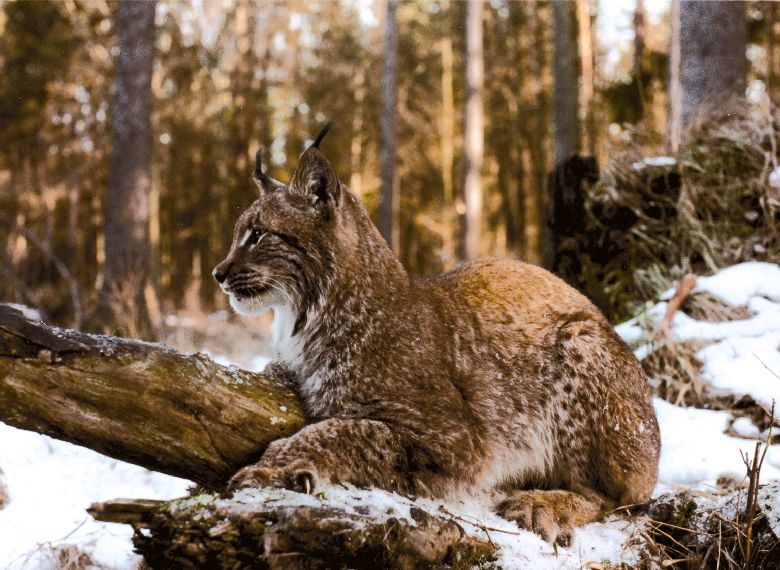
Figure 43. The lynx population
in the entire Bialowieza Forest
amounts to some 30-40
individuals (WJ)
In the central part of the Belovezhskaya Pushcha, a significant reduction in the number of ground-nesting birds has been registered; many species of rare plants and animals are becoming extinct, and the living ground cover and big invertebrates are suffering greatly. Thirty years of intensive game husbandry have substantially changed the habitat, even the soil forming processes have been altered despite soil being the natural element that is the most resistant to change.
Changes in the natural forest regeneration have endangered the very preservation of the Pushcha as a unique natural complex. Hence, an important task in the immediate future is the reduction of excessively high ungulate number, in order to balance these with the natural food supply capacity in forests. This should stabilise the ecological situation in the Belovezhskaya Pushcha.
PRESSURE CAUSED BY EXCESSIVE NUMBERS OF UNGULATES
Due to substantial changes in natural forest regeneration as a result of the intensive game husbandry in Belovezhskaya Pushcha over a period of about 40 years, it seems that simply reducing the number of wild animals would not be enough to solve the problems of natural reforestation with the natural forest types. Forest regeneration, especially on long established clearings, may require restocking and selective felling. However, long-term detailed experiments on sample plots should necessarily precede such arrangements, in order to provide an opportunity to elaborate a strategy, and to develop a methodology for implementing such a project. Otherwise, the Belovezhskaya Pushcha forests may be irrevocably affected.
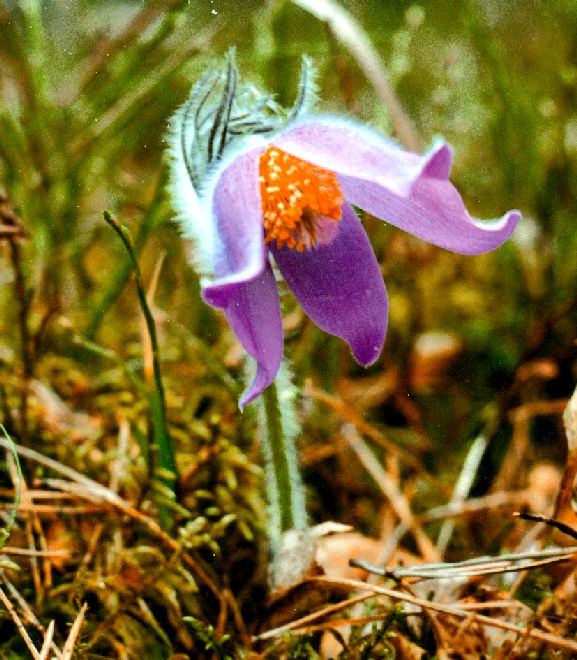
Figure 44. The Eastern
Pasqueflower (Pulsatilla patens)
is included in the Red Data Book
of the Republic of Belarus (NC)
A reduction in the number of wild ungulates is also very important for the preservation of the Bison. For more than 30 years, many Bison have suffered a serious suppurative necrotic disease that affects their genitals and, eventually, may result in collapse. The main cause of this disease is an unsatisfactory habitat due to a lack of sufficient shrub forage, since this has been destroyed by the numerous Red Deer. Shortage of proteins, vitamins, and biologically active substances in their food, and the impossibility of substitution by artificial feeding, have caused an imbalance in the physiological processes in bison' organisms, this in turn weakens the Bison and encourages disease. Inbreeding (the entire Belarussian herd has descended from only a few individuals) has contributed to the problem. Hence, a reduction in the number of ungulates, primarily Red Deer, as well as immediate restoration thereafter of the natural fodder base, are the basic prerequisites for improving the state of the Belovezhskaya bison herd.
To preserve the natural forests of the Belovezhskaya Pushcha, a Specialised Game Husbandry Area "Shereshevskoie" has been set up in the National Park Support Zone. This enterprise manages an entire complex of arrangements for breeding, maintaining and selecting wild animals. At present, animals trapped in the Belovezhskaya Pushcha are transferred to the husbandry unit to enable hunting of ungulates to continue. In the Belovezhskaya Pushcha Parks' territory proper, game shooting is to be minimised, or even stopped over time.
Thus, most hunting activity is being removed from the Belovezhskaya Pushcha. This will provide an opportunity to restore young forest generations and will also promote the preservation of one of the significant financial resources of the National Park. This is important for the Park's staff, especially in the present unfavourable economic conditions.
FORESTRY ASPECTS

Figure 45. The Lady's Slipper
(Cypripedium calceolus), one
of the rarest orchid species,
can be found in few places
in the Bialowieza Forest (AB)
For a long time, the practice has been established in the Belovezhskaya Pushcha to avoid clearance cuttings and felling the live trees. Only in the Nature Protected Zone can dead and dying wood be felled, any kind of activity whatsoever is expressly prohibited in the Wilderness Protection Zone. In the Forest Inventory Plan, only 60,000 cubic metres can be removed annually from the 240,000 m3 that is added to the dead stock. During recent years, the amount felled has amounted to 80,000-100,000 m3, mainly due to heavy droughts and the emergence of multiple concentrations of Bark Beetles. Nevertheless, felling volumes need to be optimised since dead wood is very important in the forest (the source of humus, the habitat for many rare fungi and other lower plants species, insects, etc.). The cutting volume should be calculated to reflect the forest type, ensure biodiversity does not shrink and retain sustainable development of ecosystems. Dead and hollow trees should not be burnt, but left in the forest and, in addition, non-economical wood cuttings should also not be burnt (but scattered or piled, depending on their location). It is necessary further to follow the practice to protect live trees.

Figure 46. The Greater Spotted
Eagle (Aquila clanga) only
breeds in the Belarussian part
of the Bialowieza Forest (NC)
The Belovezhskaya Pushcha is an asset to the world as a remnant of primeval forests. Hence, artificial afforestation cannot be tolerated, especially with the standard forestry methods that use heavy machinery for preparation and making furrows. Such techniques not only excessively disturb the soil and vegetation cover, they also seriously damage the roots of the old-growth trees which might otherwise live to the age of 250-300 years and make up the elite genetic fund of the Belovezhskaya Pushcha. Furrows made for seedlings excessively weaken such trees, dooming them to premature fall. Moreover, locations with artificial planting are characterised by intensive "biological" pollution of the forest - i.e. 'weed' species of plants and animals on an unnaturally large scale.
In logging areas, substantial damage to live trees, the undergrowth, and the seedlings of tree species, as well as disturbance to the grass layer continuum and soil mantle are caused by heavy tractors. To protect forest integrity, it is necessary either to reintroduce the old form of power used for transporting logs, horse skidding, or to use modern light skidding facilities. It is preferable to undertake skidding in the winter since the slightly frozen forest soil minimises damage. Another advantage is that, at this time of the year, birds and animals are less disturbed than in the breeding season.
The intensive introduction and distribution of foreign trees and shrubs poses a sizeable threat to biodiversity conservation in the Belovezhskaya Pushcha. They are a source of serious biological pollution to the primeval forest. An estimate of the intensity and spread of introduced species, and immediate action to fell and remove the most threatening species (e.g. the Red Oak Quercus rubra), needs to be undertaken.
BIODIVERSITY CONSERVATION

Figure 47. Small watercourses
contribute very much
to biodiversity (PB)
The Belovezhskaya Pushcha is located at the junction of two geobotanic zones, the Eurasiatic coniferous forests and the European deciduous forests. This leads to the rich diversity of species in the ecosystems of the Belovezhskaya Pushcha, when compared to neighbouring regions. Range boundaries of southern, western, and northern species of plants and animals cross the Pushcha's territory. Many of these are listed in the Red Data Book of Belarus (7 species of fungi, 16 of lichens, 4 of mosses, 65 of higher plants, 38 of insects, 8 of fish, 1 amphibian and 2 reptile species, 52 species of birds and 11 of mammals). Thus, an important objective of the National Park is the conservation of local populations and groups of rare species. Artificial methods of increasing numbers can be of assistance in this process, including artificial reproduction and conservation of certain types of ecosystems or specific succession stages where rare species occur.
Only predators that are specified in the Red Data Book categories are under absolute protection in the Belovezhskaya Pushcha, namely: Lynx (25-30 animals) and Badger (about 45 animals). The Wolf population is regulated, to maintain the level at some 25-30 animals, with about 10-20 individuals removed each year. The Fox population is not of great concern, since it numbers only between 100 and 200 animals. Birds of prey are protected everywhere. The Pushcha is currently in need of a strategy aimed at conserving and regulating predators in the Belovezhskaya forests. This should combine ecological and economic approaches while, at the same time, take into account the biological peculiarities of the various species.
The development of a concept and model for the conservation of the Silver Fir (Abies alba) population is an essential and urgent task. These only grow in one area on the eastern border of the Pushcha ("Tisovka Reserve"), and there are now only 20 old trees (there were about 200 in 1888).
Conservation and restoration of migration corridors is another primary task for ecologists since these passageways will assist free contact among those animals that inhabit large areas.
An optimal relationship between biodiversity conservation and economic needs can be achieved through functional zoning of the National Park. Such zoning may considerably contribute to the rational combination of passive and active protection of species and communities, and human economic activity in this territory. It is also necessary to improve and optimise the National Park zone system, and join the adjacent ecologically valuable areas within the National Park. The leading principle in this activity should be to prioritise nature-protective arrangements, that is to align the protection of communities and species with the preservation techniques used in the different zones, in other words a systematic approach to territorial zoning.
It is essential to organise monitoring to estimate pollution levels, primarily associated with cross-border transfer, in the Belovezhskaya Pushcha.
To conserve the biodiversity, and to manage the biological resources of the Pushcha, a comprehensive research programme has been elaborated, incorporating both basic and applied field studies. The main thrusts of the programme are flora and fauna surveys, monitoring of natural processes, ecological experiments, creation of an information system, simulation, the drawing up of recommendations, and their on-site implementation.
The most important pre-requisite for the conservation of the unique natural complex of the Belovezhskaya Pushcha is the precise and efficient co-operation of all the units and subdivisions of the National Park, under the guiding role of the Scientific Department.