
FOREST MANAGEMENT IN THE POLISH PART OF THE BIALOWIEZA FOREST
Piotr Zbrozek,
Regional Board of the State Forests
in Bialystok, Bialystok,
Poland
The managed part of the Bialowieza Forest, administrated by the State Forests Department, consists of about 52,000 ha of forests and forested grounds. There are three forest superintendencies: Bialowieza, Browsk and Hajnowka. Together, since 1994, they form the Promotional Forest Complex "Bialowieza Forest". Forest management in the managed parts of the Bialowieza Forest is realised in line with the forest survey which has been adopted to meet the requirements of the Amended Forest Act as well as silvicultural and protective rules introduced following a decision of the Minister of Environment Protection, Natural Resources and Forestry in 1994. In addition, there are decisions made to meet special treatments for selected elements of the ecosystems of the Bialowieza Forest. In recent years, the management of the Bialowieza Forest has been completely revised. A model of ecological management based on the principle of sustainable development is now applied. Resolutions at the Rio Earth Summit and the Helsinki conferences have resulted in the creation of new management principles for the complete ecosystem, in contrast to the previous system of stand management alone. The attitude of foresters has changed and the process is moving towards the realisation of new ideas.
ZONING IN FORESTRY ACTIVITIES
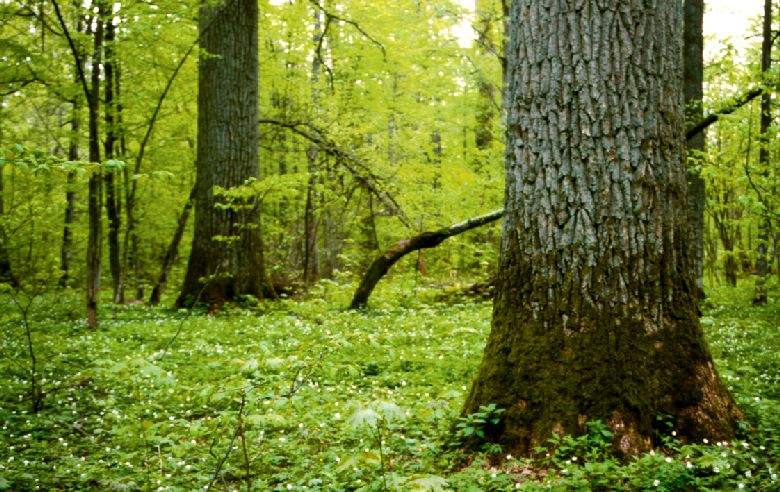
Figure 18. Natural oak-lime
forest (CO)
The managed part of the Promotional Forest Complex is divided into two zones with different silvicultural and protective regimes. The 1st Protective Zone (about 16,000 ha), situated around the Bialowieza National Park, has a special forestry regime in which the silvicultural needs of ecosystem elements determine management activities. In this zone, natural regeneration is the rule; clearance cuttings are prohibited, and soil cultivation on renovated areas is carried out manually. In management operations, the use of heavy forest equipment is prohibited and the use of chemical controls is limited to disaster situations.

Figure 19. A pine
stand (CO)
The rest of the Bialowieza Forest Complex (about 36,000 ha) forms the 2nd Protective Zone. In this area, forest management units are created according to the forest habitat type. Clearance cutting is allowed but minimised. Tree stands appropriate for conversion are determined by higher than normal cutting ages: Pine - 140 years, Spruce - 120 years, Common Oak - 160 to 240 years, Sessile Oak - 300 years, Ash - 140 to 180 years, Hornbeam - 100 to 120 years, Alder - 80 to 100 years, and Aspen - 50 years.
Harvested timber volume made only 40 % of current increasement. During stand tending preferred species are relatively underrepresented in cuttings, namely Elm, Norway Maple, Lime and Goat Willow.
ECOLOGICAL AND CONSERVATION ASPECTS

Figure 20. Forestry activity
using tractor (PB)
In all the forest complexes, natural regeneration is preferred, and only if necessary is this supplemented by planting seedlings. A basic requirement for maintaining fertility and stability of the forest habitats in the Bialowieza Forest is non-disturbance of hydrological conditions coupled with the construction of water-retaining reservoirs.
SOCIAL ASPECTS

Figure 21. Huge 600-year-old
oak tree (VE)
All management activities are evaluated by the Commune and Scientific Council of the Promotional Forest Complex "Bialowieza Forest". Education on the protection of forest ecosystems through rational management is carried out by the Forest Educational Centre "Jagiellonskie". Foresters believe that through the realisation of rational management measures, that take into account the needs of the local society, they can maintain sustainability and protect the Bialowieza Forest.
Eventual financial support to the activities of foresters in the Bialowieza Forest should enable the renovation of the narrow gauge Hajnowka - Bialowieza forest railway line.