
THE BELOVEZHSKAYA PUSHCHA FORESTS: PROBLEMS OF ECOLOGY AND MANAGEMENT
Alexandr V. Pugachevskii,
Institute of Experimental Botany,
National Academy of Science,
Minsk,
Belarus
Igor G. Romanyuk, Evgenij A. Smoktunovich
National Park "Belovezhskaya Pushcha",
Kamenyuki,
Belarus

Figure 38. Oak forest with
natural regrowth (PB)
ECOLOGICAL PROBLEMS FOR THE FOREST MANAGEMENT
The following problems may be defined as ecological ones:
- a decrease in the tolerance of old-growth forest stands to unfavourable environmental factors (droughts, hurricanes, changes in the subsoil water level, forest infestations and diseases, recreational impact, contamination, etc.), as a result of biological ageing;
- a considerable number of stands containing old trees of similar age are decaying rapidly when their natural tolerance threshold is overcome;
- difficulties with natural regeneration of native forest-forming species (Table 2), such as pine and oak, due to their weak regrowth in the presence of an excessive ungulate density that has artificially been maintained over an extended period; this process leads to the succession to a spruce monoculture with reduced presence of pine, oak, lime and ash typical of the climax lowland forest;
Table 1
Distribution of trees in the Belovezhskaya Pushcha Forests by Formations and Stand Age Groups
| Stands Formation | Young Stands | Middle-Aged | Ripening | Mature | Old | Total | Average age (years) | |
| National Park "Belovezhskaya Pushcha" Forests 1 | ||||||||
| Pine | ha | 5317 | 19375 | 2612 | 11341 | 6429 | 45074 | 101 |
| % | 11.8 | 43.0 | 5.8 | 25.2 | 14.3 | 57.97 | ||
| Spruce | ha | 252 | 3097 | 1786 | 2911 | 301 | 8347 | 112 |
| % | 3 | 37.1 | 21.4 | 34.9 | 3.6 | 10.74 | ||
| Oak | ha | 38 | 657 | 241 | 2133 | 573 | 3642 | 150 |
| % | 1.0 | 18.0 | 6.6 | 58.6 | 15.7 | 4.68 | ||
| Hornbeam | ha | 6 | 206 | 58 | 141 | 349 | 760 | 96 |
| % | 0.8 | 27.1 | 7.6 | 18.6 | 45.9 | 0.98 | ||
| Ash | ha | 1 | 259 | 307 | 325 | 892 | 133 | |
| % | 0.1 | 29 | 34.5 | 36.4 | 1.15 | |||
| Maple | ha | 10 | 8 | 48 | 66 | 149 | ||
| % | 15.1 | 12.2 | 72.7 | 0.08 | ||||
| Birch | ha | 123 | 4174 | 1029 | 985 | 132 | 6443 | 59 |
| % | 1.9 | 64.8 | 16 | 15.3 | 2 | 8.29 | ||
| Aspen | ha | 3 | 25 | 79 | 384 | 144 | 635 | 64 |
| % | 0.5 | 3.9 | 12.4 | 60.5 | 22.7 | 0.82 | ||
| European Alder | ha | 112 | 3280 | 2198 | 4073 | 2214 | 11877 | 76 |
| % | 0.9 | 27.6 | 18.5 | 34.4 | 18.6 | 15.28 | ||
| Lime | ha | 11 | 3 | 14 | 61 | |||
| % | 78.6 | 21.4 | 0.02 | |||||
| Grand Total, National Park | ha | 5852 | 31094 | 8321 | 22341 | 10142 | 77750 | |
| % | 7.5 | 40.0 | 10.7 | 28.7 | 13.0 | 100 | ||
| All forests under the Ministry of Forestry, Belarus 2 | ||||||||
| % | 37.0 | 42.7 | 15.7 | 4.6 | 100.0 | |||
| 1 Data on the State National Park «Belovezhskaya Pushcha» are based on forest inventories.. 2 Based on data of the RB Ministry of Forestry | ||||||||
Table 2
Availability of undergrowth in old-growth forests
| Forest Formation | Area of Ripening, Mature, and Old Stands |
Area with undergrowth |
Areas with thick undergrowth A |
Undergrowth Composition B |
||
| he | % | he | % | x10% | ||
| Pine | 20382 | 18595 | 91.2 | 10034 | 50.0 | 8S 1H 1B |
| Spruce | 4998 | 4478 | 89.6 | 3076 | 61.5 | 8S 2H |
| Oak | 2947 | 2387 | 81.0 | 1652 | 56.0 | 5S 4H 1As |
| Hornbeam | 548 | 438 | 79.9 | 299 | 54.6 | 5H 4S 1M |
| Ash | 632 | 594 | 94.0 | 491 | 77.7 | 6As 3S 1H |
| Maple | 56 | 32 | 57.1 | 25 | 44.6 | 9H 1As |
| Birch | 2146 | 1786 | 83.3 | 776 | 36.2 | 7S 2H 1As |
| Aspen | 607 | 393 | 64.7 | 227 | 37.4 | 8S 2H |
| European Alder | 8485 | 7781 | 91.7 | 4083 | 48.1 | 7S 2As 1A |
| Total | 40781 | 36484 | 89.4 | 20663 | 50.7 | 6S 3H 1As |
| A "thick undergrowth" means areas with undergrowth of
native wood species, with at least 3,000 pieces per hectare with an average height of at least 0.5m. B S, H, B, As, M, A indicate the forest types dominated by Spruce, Hornbeam, Birch, etc. |
||||||
- poor pine regeneration due to the effective fire protection in the Pushcha forests which has led to the formation of a thick moss cover and ground litter which hinders germination and seedling rooting;
- a fall in the biodiversity, and a deterioration in the conditions for natural regeneration of spruce and oak, as a result of complete stand removal in dry habitats;
- a retarded renewal of the soil profile in forest ecosystems due to a reduced volume of natural pedoperturbations as a consequence of complete stand removal in dry habitats in the course of sanitary cuttings.
ECONOMIC PROBLEMS ASSOCIATED WITH ECOLOGY AND FOREST MANAGEMENT
Economic problems with forest management practices are closely related to ecological and forestry problems. These are:
- low profitability of felling because of the low-quality timber from old-growth stands of dry habitats;
- inability of efficiently logging of dead trees in dry stands due to the lack of specialised equipment and difficulties with the mechanisation of the process;
- inability to accurately plan logging due to irregular tree dying processes and the lack of forecast data on these processes in the Pushcha forests;
- the impossibility of using the National Park sawn-wood production facilities at full capacity through regulated use of dead and dying trees and, consequentially, the necessity to procure additional funds.
ECOLOGICAL AND ECONOMIC PROBLEMS ARE INTERWOVEN
Problems in the forestry production branch are closely interwoven with ecological and economic issues; the more so as all these problems have to be mainly solved through the application of available forestry methods and by the restricted number of forest workers. Among the problems one can list:
- the necessity to fulfil routine (and above the planned) yearly cuttings by limited forestry manpower, under conditions of relatively low need in sanitary cuttings;
- the complexity of afforestation after sanitary cuttings due to both rapid grassing over and ungulate activity which destroys preliminary undergrowth and self-sown species and cultivars;
- the necessity to match the interests of the forest proper with those of game hunting and tourism, without the necessary regulatory and/or recommendatory documents.

Figure 39. Bison at a storage depot
for cut trees in a forest clearing (WJ)
CHALLENGES FOR THE FORESTS' MANAGEMENT

Figure 40. Young oak
seedling (NC)
The first steps towards solving the problems of the Belovezhskaya Pushcha forests' management should be:
- the use of large-scale investigations into the current dynamics and structure of these forests in relation to the forest management regimes and the dynamics of climate (in particular, the study of demographic processes in populations of the forest-forming tree species, the ecological consequences of multiyear removal of dead wood from the forest, the study of post-catastrophic dynamics of spruce forests; moreover, an analysis of the after-effects of a reduction in the ungulate density);
- experimental work aimed at actively stimulating natural regeneration of, primarily, oak woods and pine stands in the Pushcha;
- a critical analysis of the adopted practice of logging, including the selection of trees for cutting, the methods of felling, and the clearing the cut areas;

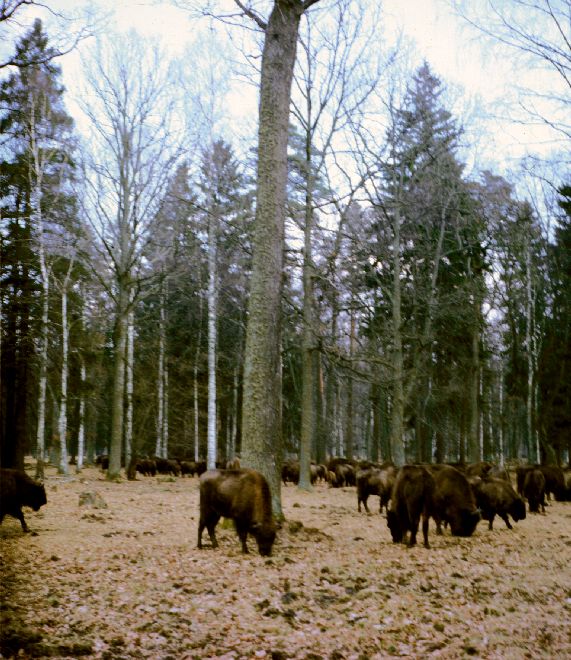
Figure 41. Herd of Bison at the
winter feeding place (AB) - the analysis of the current functional zoning of the Park's territory, including the newly added areas and the necessity of more profound differentiation in the adapted forestry practices. However, the current Wilderness Zone should keep its present status.
Taking into account the status of the National Park, scientific support and adequate zoning of recreational activities in the Belovezhskaya Pushcha forests is very important.