
The Uniqueness and Value of Belovezhskaya Pushcha
It is an obvious and very prestigious honour to rank among famous natural treas-ures as those mentioned in the previous chapter. This is the best proof of the excep-tional importance and uniqueness of Belovezhskaya Pushcha on the planet Earth. What is its precise value?
If we address to documents of UNESCO we find the following record: "the CONSERVATION VALUE of Belovezhskaya Pushcha: a stretch of ancient, virgin, palaearctic forest, which in comparison to other lowland European forests has endured little human disturbance. The site presents a habitat for several internationally threatened species (MAB-Belarus, 1993)".
We add to these words that the Belovezhskaya Pushcha is the only large rem-nant of the relic primeval lowland forests that have existed all over Europe since pre-historic times. For centuries nearly all truly virgin forests have gradually been felled while Belovezhsky is the only region where the truly natural and authentic primeval forest remained more or less intact on a large scale. The Belovezhskaya Pushcha as a large forest area is a refuge of genes and a reference for primary natural processes which are characteristic for the lowland of Central Europe.
The average age of forest stands within the Belovezhskaya Pushcha-complex is more than one hundred years and separate patches of the forest are aged 250 to 350 years. More than one thousand giant trees in the Pushcha have been officially regis-tered thanks to their size and age. Among them are 400 to 600-year old Oaks, 250 to 350-year old Ashes and Pines and 200 to 250-years old Spruces.
Through the last centuries the Belovezhskaya Pushcha Primeval Forest has saved its wild primary attributes and relic plant and animal communities populate the forest. The richness of species of plants and animals in Belovezhskaya Pushcha is surpassed nowhere in other lowland areas of Europe. More than one hundred forest types - large-scale categories of vegetation - are registered here. 1040 species of high vascular plants, 260 mosses, more than 375 lichens and more than 3000 types of fungi do grow here. The Fauna List of Belovezhskaya Pushcha includes 59 spe-cies of mammals, 227 birds, 7 reptiles, 11 amphibians, 24 fish and more than 11,000 species of invertebrates. Insects alone number over 9,500 species. The largest worldwide population of European bison (Belovezha subspecies) inhabits the forests of Belovezhskaya Pushcha. In terms of large herbivorous animals Red deer, Wild boar, Roe deer and European elk can be found and amongst predators Wolf, Fox, Lynx, Badger, Pine marten, Otter and others species are present. Many rare and threatened species of birds - inhabitants of primary forests and mires - populate the forest. These include White-tailed eagle, Shorttoed eagle, Black stork, Crane, Lesser spotted eagle, Great grey owl, Pygmy owl, White-backed woodpecker, Three-toed woodpecker, Roller and many other species. Specific species like Black grouse, Capercailzie, Greater spotted eagle, Eagle owl, Roller and Aquatic warbler have dis-appeared in the Polish part of Belovezhskaya Pushcha, but still populate the Belaru-sian side. Belovezhskaya Pushcha has retained unique associations of invertebrates, inhabitants of dead and rotten wood, Polyporus fungies and bogs and fens.
 |
375 species of lichens grow in Belovezhskaya Pushcha. (Evernia, Lobaria) |
 |
| .over 3000 species of fungi . (Honey Agaric) |
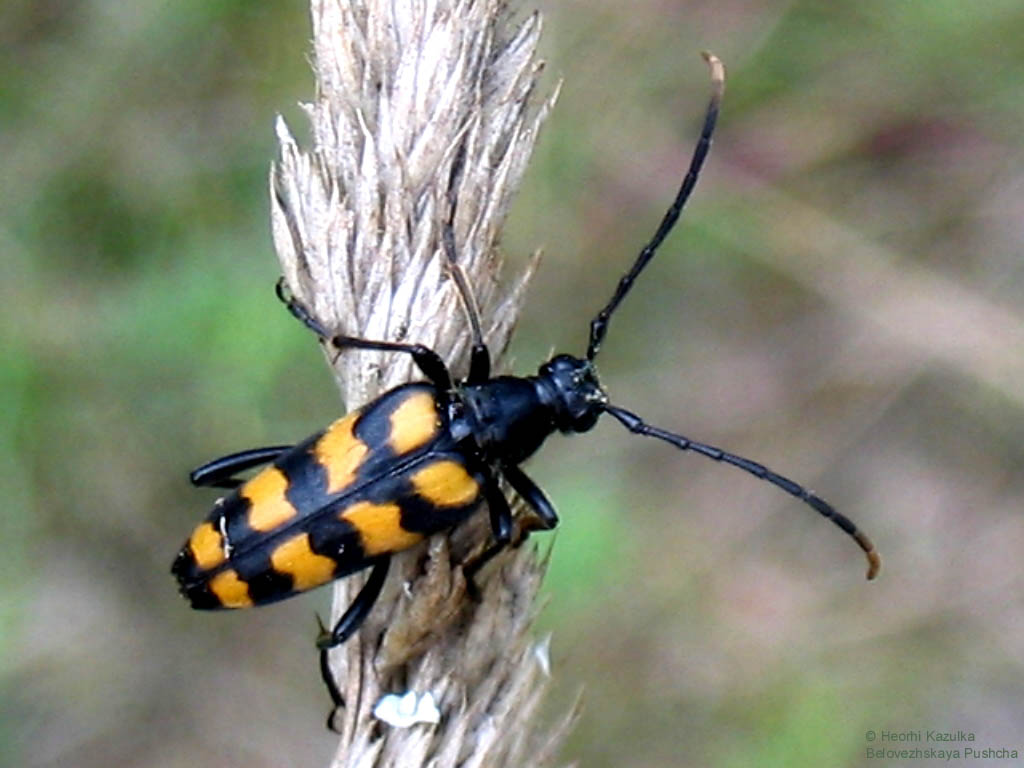 |
| .over 9500 species of insects (Leptura Beetle) |
Belovezhskaya Pushcha is the oldest Reserve of Europe. The natural heritage of Belovezhskaya Pushcha has been protected since the 14th or 15th century. Nowa-days the whole territory of Belovezhskaya Pushcha in Belarus is a National Park and a Biosphere Reserve.
All the unique and valuable features mentioned here have promoted the inclusion of the Belovezhskaya Pushcha Primeval Forest as the relic into the List of World Heritage Sites of Mankind.
 |
 |
| The Bluebell flower | The Orchis flower |
The World Heritage Site consists of two parts: Bialowieza National Park in Poland and the core of the Wilderness Protection Zone of the Belovezhskaya Pushcha National Park in Belarus (Figure 1). The Committee for Protection of the World Cultural and Natural Heritage of UNESCO inscribed this transboundary natural area as a single object called Belovezhskaya Pushcha / Bialowieza Forest (Belarus / Poland) in the List of Natural Heritage Sites.

Figure 1. Scheme of the Polish Biosphere Reserve "Bialowieza Forest" and Bel-arusian Biosphere Reserve "Belovezhskaya Pushcha" and the location of the World Heritage Site "Belovezhskaya Pushcha / Bialowieza Forest".
(This scheme was presented by the Centre of Wilderness Protection in Russia)
Note: The Core Zone and Buffer Zone of the Biosphere Reserve are property of the administra-tions of Belovezhskaya Pushcha National Park and Bialowieza National Park. The transition Zone in Poland is under subordination of the Promotional Forest Complex "Bialowieza Forest" of State Forestry Service in Poland. In Belarus the ownership of this Zone is divided over the National Park (after a substantial recent extension), state forest enterprises and collective farms. The World Heritage Site Belovezhskaya Pushcha belongs to the Core Zone of the Biosphere Reserve.
Apart from a World Heritage Site (since 1992), covering the core area of the Wil-derness Protection Zone, the whole Belarusian part of Belovezhskaya Pushcha is protected as a National Park (since 1991) and as a Biosphere Reserve (since 1993).
(Photos made by the author)