
Uncertain future for Bialowieza Primeval Forest*
or Sustainable Forest Degeneration in Bialowieza
Bart van der Linden, Harm Smeenge and Frank Verhart
Received January 2005
*This article will be published in some short form in Vakblad Natuur Bos
Landschap (the Netherlands) magazine
Summary
The Polish and Belarussian strict nature reserves of Bialowieza Primeval Forest are recognised as unique woodlands within the lowland of Europe. Commercially exploited parts of Bialowieza, in which an ecological network of "old growth"-stands is present, do surround these reserves. The "old growths" possess natural qualities comparable to the strict reserved parts. However, due to internal and international political interference and deeply rooted conflicts on managing the woodland as a single area, protected or formerly protected stands are being cut down under pretext of controlling outbreaks of Bark beetle. This is a major threat for the preservation of this unparalleled World Heritage Site and World Biosphere Reserve. A primary solution can be found in putting a ban on cutting trees in "old growths". Transboundary cooperation aimed at an ecological coherence of forest protection, forest and hydrology management and development of ecotourism must be persisted and intensified.
The Bialowieza Primeval Forest

(The Bialowieza Primeval
Forest)
A primeval forest is made up of a mosaic of forest ecosystems, which vary according to the soil conditions: dry, wet, humid or low moor-like. Man has not degraded the environment of this reserve and its soil, its hydrological situation and its forest stands. Since elements like trenches are nearly completely absent considerable parts of the forest are periodically flooded by water. In spring the snow-melt water drains off over hollow depressions, which is one explanation for the fine tuned differentiation of nutrients. This process is what essentially determines the presence and distributions of typical vegetation. The presence of dead wood, resulting from storm, natural mortality or enfeeblement by insects or fungi is essential within forest ecosystems like Bialowieza. Natural conditions and processes result in the development of mosaic-like structures at various scale levels. These are characterised by a varied composition of species and a spatial variation of patches of forest of diverging age classes. However, the volume of dead wood varies greatly from place to place. Lynx loom on spots with high concentrations of lying dead trees (cages). Red deer and Roe deer which live in their neighbourhood keep their distance of such places. This allows the forest to regenerate in these places where dead wood is present in concentrated volume. Within gaps of a certain size, which naturally occur in ancient forests, regeneration happens in light demanding species, such as Hazel and Oak. Shade tolerant tree species, like Hornbeam and Linden, sprout within smaller gaps. The biological diversity of Bialowieza Forest is surpassed nowhere in the lowland of Europe. It is a unique entity which demands proper protection.
The "sustainable" multifunctional Bialowieza Forest
Before World War One started, about 70% of the forest stands of Bialowieza were being classified as so called "old growths". These stands are aged one hundred years and older. They show a more or less natural age distribution among their trees, a natural spatial distribution of dominating phases in forest development and a nearly pristine forest floor. In the current situation trees of the higher age classes within the old growths sprouted before World War One. That war was the first period in which dramatic volumes of wood have been harvested within Bialowieza Forest. At the beginning of the 21st century the share of old growths has dropped to cover about 25% of the multifunctional part of the forest, which makes up ca. 50,000 hectares, being 83% of the Polish part of Bialowieza. Despite a persisting decline of the grade of naturalness of the forest, its managers are still not prepared to limit the level of annually felled wood nor to reduce the use of heavy tractors adopted to forest exploitation. As a result the future of undisturbed ecological processes and the destiny of many species has become more uncertain than ever before.
Within the exploited area of Bialowieza the Old Growth stands make up essential remnants of the virgin forest. In these stands the elements which characterise the primeval wood have been conserved comparatively well. The forest structure is nearly natural. It contains a wide array of ecological niches which are absent elsewhere, having been lost because of the levelling impact of the adoption of multifunctional forestry methods to objects with exceptional natural qualities. Typical species of undisturbed settings, such as White backed woodpecker, Pygmy owl, Eagle owl and many epiphytes and invertebrates can maintain themselves only in (nearly) natural forests of a sufficient area. Such habitats include the Bialowieza National Park and old growths, provided the latter areas are large enough and/or strongly ecologically connected. However, the intense management has considerably weakened the network of old growths. This leads to the disappearance of sensitive species such as the Pink frog orchid. The distances between the remaining stands of old age increase, while the habitats within the managed forests do not meet the size or quality which the most ecologically demanding species of the forest ecosystem demand. In fact the island theory applies to such species as isolated islands appear within the forest and ecological barriers arise. Bialowieza is a vast woodland area of which the ecological quality varies largely over the area. Large scale surfaces of young artificial stands hinder specific species in their migration and distribution. This applies to a category of species which have been lost in forests with a less natural character.
The managed part of the Bialowieza Forest is home to rare and interesting natural values, which may serve as a reference for the long term perspective of the European lowland within the temperate climatic zone. It is essential to recognise and respect this fact. However, in comparison with the strict forest reserve of Bialowieza National Park and the remaining old growths there is limited capacity for spontaneous processes; space for the complete range of natural diversity is limited. The main cause for this is the fact that natural balance is being disturbed by the continuous pressure of forestry oriented management. Within Bialowieza the principles of 'sustainable forestry' are being adopted. For ten years the area has been classified as one of a dozen so-called Promotional Forest Complexes that the Polish State Forest Service has proclaimed. This status implies that, apart from ecology and harvesting wood, the forest managers pay attention to aspects of recreational use and a visually attractive landscape. The modern Bialowieza Forest excludes many characteristics of a pure primeval forest.
Integral planning in Poland
The Polish government set up a specific policy for the management of the entire woodland of Bialowieza. These ideas have been described in "The Contract for Bialowieza Forest". This plan outlines the possibility to preserve the forest and methods to improve the socio-economic position of the local and regional population of Bialowieza. According to these ideas the forest would essentially be divided over several zones, each with a specific regime of conservation. In some areas strict protection of the most ecologically valuable parts gains overall priority, while there are zones in which sustainable harvesting of wood by the local population are defined. The plan pays attention to the socio-economic situation, including stimulating ecotourism. Implementation of this plan would ultimately lead to an integrated protection of the entire Bialowieza Forest as a National Park, which is the highest status of nature protection in Poland.
Danish management plan versus ecological degradation
The Polish State Forests administration has almost simultaneously set up an alternative plan. It aims to implement sustainable forestry in the managed part of Bialowieza Forest. This type of forest management is being applied almost everywhere in Western Europe in order to reshape forests focused on wood production into well-varied multifunctional forests. This type of forest management contributes to an increase in the biological diversity and spatial variation of such unnatural forests.
In this regard sustainable forestry is a true success. Within the Netherlands for example this change is being reflected by an enormous increase in numbers of the Black woodpecker and a modest return of the Middle spotted woodpecker. No matter how favourable this type of management can be within cultivated forests, this does not eliminate the fact that reshaping large scaled forests of the nearly natural type into a multifunctional woodland causes an ecological catastrophe. This type of forest management is the cause of an overwhelming number of signs "forestry in progress" in Bialowieza.
According to the forest management plan, ratified July 1, 2003, a yearly harvest of about 150,000 m3 of wood will be realised yearly until 2011. This volume is out of proportion as research has shown that only 40,000 to 70,000 m3 are needed to meet the local demand for wood. The annual harvest of wood increases by about 40% according to the plan, when compared to the level of the past decade, in which the natural quality of the forest has already strongly declined. The impact of this measure is being intensified since the 40% increase is being harvested on - a theoretical - 14% smaller area of woodland! This is a consequence of the implementation of new forest reserves of ca. 8,500 hectares which were created shortly after the mentioned date. The Council of Europe advised to implement the plan of the Polish State Forests Service.
An prohibition (ban) on cutting down trees aged over one hundred years was adopted in 1998 as a preliminary measure for the extension of the National Park. This has been toned down to such an extent that the managers are in fact licensed to remove even the oldest giant Spruce from the forest ecosystems of Bialowieza. The only condition which must be met is an infestation of a tree by insects such as the Bark beetle (Ips typographus). Such beetles are usually present in trees at that age, as they are more vulnerable than young ones.
The character of both plans clearly and evidently diverges. Out of both plans the one was implemented which clearly limits the ecological functioning of Bialowieza Forest. It turns out that the forestry lobby in Poland is a powerful movement. This may be understood easily as it is the largest land owning organisation in Poland, but could never be accepted to explain the actual doubtfulness of sustainable preservation of Bialowieza Forest. The current management plan of Bialowieza Promotional Forest Complex highly corresponds with recommendations of DANCEE (Danish Cooperation for the Environment in Eastern Europe). A favourable development is the enlargement of the surface of reserved forest stands outside the National Park with 8,540 hectares to a cover of nearly 12,000 hectares, implemented in July 2003. However, also within these reserved areas trees of all ages infested by insects, including Bark beetle, are being removed. In particular ancient Spruce trees, which locally reaches a height of 50 metres, are being felled. Up to date Polish forestry does not tolerate natural decay of trees killed by "pest" insects, notwithstanding the unique position of Bialowieza Forest from the European perspective. Within the lowland countries in Western Europe it is nearly needless to write about the ecological importance of the process of natural decay, which here is being coupled with formation of unprecedented numbers of ecological niches, to which in turn a major share of the living organisms in forests owe their right to exist.
Managing Bark beetle.
Many foresters fear outbreaks of pests of insects when large numbers of broken or dying coniferous trees are present in the forest resulting from storm damage or decay. Bark beetle is the "most wanted" species. Scientific research has shown that these fears are not rightly. Plagues can be enforced when dead trees are being removed. The Swedish entomologist Gunner Isacsson is an experienced specialist in the field of plagues of insects. He states that trees should not be cut down within protected natural forests. His research within Sweden and Lithuania shows that infestations of Bark beetle control themselves in three or four years if Spruces "under attack" are not being cut down.
Within natural forests removal of death Spruces during winter may promote the population of Bark beetle, since its natural enemies are being removed from the forest ecosystem as well in that period. This is so as predators of Bark beetle hide themselves under the bark of trees. The most appropriate method to "fight" the insects is to combine felling (outside the winter season) with peeling the bark of infected trees. The peeled bark acts as a trap for insects. This method has turned out to be very effective within Swedish woodland, but is not suitable in natural forests and reserved forests according to Isacsson. Within primeval forests the natural balance ensures long term health.
Jerzy Gutowski studies the ecological factors and the dynamic processes which set the conditions for development of populations of insects within the Bialowieza Forest. The results of his observations are in line with those of Isacsson. According to Gutowski the influence of removal of infected Spruces is only significant within managed areas in May and June. In these months the first generation of Bark beetle generates itself on trees which have been colonised recently by individual insects. If infected trees are being felled in the period July - September predators and parasites of insects are strongly being undermined in number as well. To a lesser, but still strong degree the same applies for the period from October to March, when the enemies of Bark beetle hide themselves in the same trees as the insects they predate. According to Gutowski a year round regime of felling trees can only be justified as a basis for demand for commercial and industrial felling of venerable wood. He emphasizes the importance of protected parts of the forest, in which trees normally complete their entire life cycle, including natural decay. On these grounds the felling of trees is wrong as it would interfere with the natural course. This contradicts the preservation of natural processes. It leads to an increase in the amount of light within the forest. Many trees adjacent to felled areas suffer drought and damage of felling. These trees weaken. In this way they are an easy victim for new plagues of Bark beetle. According to Jerzy Gutowski many myths or believes are being spread in order to justify the voluminous production of wood in Bialowieza Forest.
The culture of forest management in Western and Eastern Europe
Within several Western European countries, among which the Netherlands and Belgium, sustainable, multi-purpose or integrated forest management are adequate, modern management strategies, regarding the character of the greater part of forests in Western Europe. As a principle it is desirable to guide the sylvigenesis in such way that all demands made by society can be met. In this view the popular method of integrated forest management aims to reach a steady balance of commercial forest exploitation, recreational aspects and the preservation and development of ecological values. Above all the latter aspect has received considerably more attention over the last decades. The extent of human impact on forests has been great and ever present within the memory of man in the densely populated (North-) West of Europe. Regulating forests and the natural environment has in time become part of our culture. As our forests served various uses for man there was no other way either.
Within parts of Central and Eastern Europe the adopted forest management methods cannot be compared with the Western European uses resulting differences in cultural-historical development. Thanks to the isolated situation of vast areas in Central and Eastern Europe, smaller and larger tracts of primeval nature have been able to persist deep into modern time. The Bialowieza Forest is an excellent illustration of this. The influence of man on the forest ecosystems on Bialowieza has been relatively small and rather constant over the last 8,000 years - ever since the forest started its development. Until recently local people lived in harmony with the natural environment. Bialowieza Primeval Forest benefited a protected status as it was a permanent hunting domain of kings and tsars for many centuries.
Within the present Bialowieza it is abundantly plain that specific primeval qualities of the forest - structure, biological diversity, naturalness of soil and vegetation, micro gradients - have been done no good resulting continued intensive tree removal. Therefore adoption of multi-purpose forest management principles within undisturbed natural systems can never serve as a blueprint. Apart from this, the decline of the share of old growths carries on since this management system is being applied. This results in a lasting decline of the internal ecological relations of Bialowieza.
The Forest Stewardship Council (FSC) has certified the forest area of Bialowieza in 1999. Alas, in practice this did not imply a safeguard of the specific ecological qualities of the forest. Childlike simplicity explained this fact. The FSC-quidelines basically guaranteed preservation of a forest area with ecological qualities which were considerably lower than those present in natural forests. As such the ecological goal had been set lower than the qualities which were present in shares of Bialowieza Forest. In march 2004 the FSC-certification was withdrawn from Bialowieza Forest! Five Polish environmental NGO's submitted their complaint describing 43 cases in which the foresters of Bialowieza Promotional Forest Complex (Polish State Forests Service) violated 18 of 56 Principles and Criteria of FSC for Good Forest Management. This should be considered a new, but clear indication of insufficient concern for maintaining the unique qualities of Bialowieza Forest, such as fully or nearly natural processes
Visit by the authors
Immediately after the new forest management plan was adopted in July 2003 the authors of the article undertook a study-tour to Bialowieza. We ascertained ourselves that both within and outside of reserves great numbers of old, thick Spruces had been felled. Not infrequently trees aged over one hundred years had been pulled down. Many withering and dying trees had been removed as the managers of Bialowieza regard dead wood as a germ for harmful pests. Throughout the forests warning signs have been placed with the text "wanted: these dangerous beetles", made up in Western style. These signs, sponsored by DANCEE, explain the public of the way these evildoers would wreck the forest. Unfortunately no mention is made of the facts that such infections only occur on temporarily basis and that insects can never menace large tracts of natural forests thanks to the small-scaled mosaic-like structure of their forest associations. The presence of great numbers of insects is a phenomenon with a limited reach. It occurs naturally.
WWF appeal
WWF Poland organised a press conference two months before ratification of the new forest management plan for Bialowieza Forest. The Fund presented potential threats of its implementation. During the press conference an appeal to maintain the interdiction to fell trees aged over one hundred years, signed by 130 Polish professors. The appeal was sent to the President and Prime Minister of Poland earlier.
Press response
Since July 10, 2003 negative rumours related to Bialowieza's forest management and related subjects turn up with a certain regularity. Unfortunately the news gets limited public attention, since the Polish media are hardly touched by the interventions in Bialowieza. In the end the forest is being managed in a "sustainable" way, it bears the name of a "Promotional Forest" - a term not available for just any forest complex. Timber is being extracted and 1/6th of its cover is yet under strong protection (National Park and World Biosphere Reserve). Still attention of the media may be the best key to better protection as the German research office Market concluded that in the opinion of 77% of the citizens of Poland more forests should be protected, for example as a National Park.
The British media BBC, Telegraph and Guardian headlined in July and August 2003 with "Chainsaws let rip in Europe's oldest forest" and "Primeval forest faces death by chainsaw". In these interviews the managing director of Bialowieza National Park and specialists of WWF Poland and the Society for Protection of Birds in Podlasie strongly agitated against activities executed within the commercial part of Bialowieza Forest.
In the Polish newspaper Gazeta Wyborcza ecologist L. Betker wrote about (a minimum of) seven giant Common oaks which have been extracted from the forest without permission. However, the author makes notice of the fact that the regional directorate of the Polish State Forest Service intended to start monitoring the old Common oaks of Bialowieza. It renounced this resolution later without any elucidation. A scientist of the Bialowieza Geobotanical Station wrote to one of the authors of this article that "we can hear that many trees are being felled at all time in Bialowieza. Large lorries enter the wood to transport it. These activities are truly devastating for the Forest".
WWF drew international attention in November 2003 for illegal fellings in progress in Bialowieza Forest. Ducan Pollard, Head of WWF's European Forest Programme, stated "How can Poland credibly talk about forest protection in Europe to all other countries if on their doorstep they allow the destruction of the continent's most valuable forest?".
Response from the sector
At the end of 2003 not less than 34 Polish scientific experts in the field of nature protection send an open letter to the most important governors of Poland, Belarus and the European Union. They wrote that they were alarmed by the interventions adopted in great parts of Bialowieza Forest as we outlined previously. They point at the unique scientific, natural, environmental and cultural value of the entire area of Bialowieza Forest. They decided to resume the "fight" to enlarge the cover of the National Park as they are convinced that the entire forest deserves this status. The scientists involved set up a campaign and they look for contribution of other scientists and the inhabitants of Europe.
The Polish experts dedicate themselves to a direct interdiction on cutting trees in the reserves and within the National Park, protection of the reserves in cooperation with biologists and commissions and the enlargement of the National Park to the entire Bialowieza Forest, by which is meant that the entire Polish-Belarussian Bialowieza Forest would become protected. The scientists advocate to call the area the first transboundary Ancient Forest Park of Europe. According to them this would not mean that felling trees would become a measure of past time. However, the experts stress that any action must be limited to one third or fifty percent of the current extent. Felling must be entirely pointed to forest stands which have been adapted by previous measures. In such stands harvesting aimed at transformation is acceptable.
We warmly support the intentions and decisions made public in the petition aimed at phasing out the intensity of management measures. By investing in an adequate management plan, which honors the unique value of Bialowieza Primeval Forest, and by adopting a social-economic policy, which offers the human inhabitants of Bialowieza Primeval Forest, future generations will be able to benefit and enjoy the invaluable source of knowledge and the exceptionally important monument of nature which the Bialowieza Primeval Forest is.
The authors support protection of and research into the nature of the Bialowieza Forest. They maintain contacts with advocates of optimal protection of the Bialowieza Forest, being most of all the Polish Society for Protection of the Bialowieza Forest and the Belarussian initiative group Belovezhskaya Pushcha - 21st Century.
References
1. BirdLife International, Olgolnopolskie Towarzystwo Ochrony Ptakow (OTOP), Royal Society for the Protection of Birds & WWF, 2003. Conservation of the Bialowieza Forest. Council of Europe.
2. Bobiec A, 2001. Living stands and dead wood in the Bialowieza Forest - suggestions for restoration management. Forest Ecology and Management 165 (2002), pp.125-140.
3. Bobiec A, 2001-2003. Preservation of natural and historical heritage as a basis of sustainable development - Multidisciplinary analysis of the situation of Bialowieza , Poland.
4. DANCEE, 2001. Background to management guidelines for Bialowieza Forest. The Bialowieza Forest DANCEE Project, Bialowieza.
5. Dajdok Z. & Tomialojc L., 2003. The Tragedy of the Bialowieza Forest. Nature Conservation Committee, Polish Academy of Sciences.
6. Falinski, J.B. et al., 1968. Park Narodowy w Puszczy Bialowieskiej. Panstwowe Wydawnictwo Rolnicze i Lesne, Warsaw.
7. Falinski J.B., Kwiatkowski W., 1994. Phytocoenosis - Supplementum Cartographiae Geobotanicae 6. Warsaw, Bialowieza.
8. Gutowski J. M., Jedrzejewski W., Bobiec A., Falinski J. B., Okolow C., Popiel J., Jedrzejewska B., Brzeziecki B., and Korczyk A.. 2000. Principles of the Bialowieza National Park functioning after its extension onto the entire Polish side of the Bialowieza Primeval Forest (proposition). Bialowieski Park Narodowy, Bialowieza.
9. Van der Jagt et al, 2000. Geintegreerd Bosbeheer - praktijk, voorbeelden en achtergronden. Uitgave EC-LNV nr. 50. Ministerie van LNV, Wageningen.
10. Jansen H., 2002. Belovezhskaya Pushcha. Nieuwe Wildernis 26 (2002), pp. 5-8.
11. Kossak S., 2001. The Bialowieza Forest Saga. Muza SA, Warsaw.
12. Kempf C., 1997. Bialowieza - Primeval Forest of Europe. Setec, Bialystok
13. Polish Ministry of Environmental Protection, Natural Resources and Forestry, 1998. The Contract for the Bialowieza Forest.
14. Smeenge H., 2001. De wisent in Nederland. Vakblad Natuurbeheer 3 (2001), pp. 37-40.
15. Smeenge H., 2001. Het oerbos van Bialowieza. Vakblad Natuurbeheer 11-2001.
16. Verhart, 2003. Een orchideeenseizoen in het oerbos van Bialowieza. Eurorchis 15 (2003), pp. 11-38.
17. Wesolowski T., 2003. Three approaches to the present Bialowieza Forest Situation.
18. Wiecko E., 1972. Puszcza Bialowieska. Panstwowa Wydawnictwo Naukowe, Warsaw.
19. WWF, 2003. State of Europe's Forest Protection. WWF, Vienna.
Websites
1. The Bialowieza Forest Institute
2. The Society for Protection of the Bialowieza Forest (with references to the articles published by Guardian, Telegraph and BBC)
3. The Bialowieza Forest Campaign (published the facts found by dr. L. Betker and the open letter of 34 Polish scientific experts in the field of nature conservation)
4. Belovezhskaya Pushcha - 21st Century
Acknowledgement
Jim Bomfort (UK) corrected the English translation. We received feedback on the text presented from several involved parties. Thanks go out to those who supported our efforts (family, friends, colleagues) and to parties which offered the possibility to study the unqiue natural phenomena of Bialowieza Forest, being the administration of the Bialowieza National Park and the Bialowieza Geobotanical Station of Warsaw University.
Under the canopy of Bialowieza Forest
In our view there is honour to witness the royal atmosphere of the ancient Bialowieza Forest complex. We have had the opportunity to see, feel, hear and taste this wild natural corner of our enlarged European Union several times. The photos presented have been made in July 2003 and in July 2004. A few of the images - depicting pure nature - were recorded at previous visits. The authors of the pictures are Frank Verhart and Harm Smeenge.
Gallery-Appendix
The Bialowieza Forest (natural / managed)
.reknown as the most natural large scaled lowland forest within the moderate climatic zone of Central and Western Europe.
01  |
02  |
03  |
01. An endless mosaic of natural lowland forest communities (Bialowieza National Park - strict reserve)
02. Ancient fragment of Oak-Linden-Hornbeam, the most wide spread forest type of Bialowieza
03. "Old Growth" tree stand (> 100 years) in the managed Bialowieza Promotional Forest Complex
04  |
05  |
06  |
04. High volumes of dead wood offer many ecological niche
05. Alder-Ash forest with a natural character attending the Podcerkowka stream (Promotional Forest Complex, sector 642)
06. Amazing forest floor cover with bear's garlic along the Zebra Zubra educational trail (Promotional Forest Complex, sector 426)
.the National Park (10,500 ha), especially the strict reserve, manages itself for 8,000 years. Its character is unparalleled within the European Union.
07  |
08  |
09  |
07. Natural forest gap (Bialowieza NP, strict reserve, sector 370)
08. Pine may reach 42 m. high and 350 years without human intervention (Promotional Forest Complex)
09. 80 year old "Century Company stand" (Promotional Forest Complex, sector 99)
10  |
11  |
10. Mosaic with 200 year old Common oak (Bialowieza NP, strict reserve, sector 398 along educational trail)
11. 80 year old "Century Company stand" (sector 99)
The forest management plan ratified July 10, 2003 focuses among others on reshaping so called "Century Company stands". These are secondary stands which grew spontaneously after mass clear cutting activities of the British company Century in the 1920's.
Century Company stands have an interesting character: natural regrowth on primary forest floor. Weaker specimens of three species with high share - Spruce, Birch, Hornbeam - are starting to decay. Other species will take the opportunity to replace their ecological niche. From the ecological point of view interventions are completely unnecessary, as was the case in previous millennia.
The Bialowieza Forest (managed)
.managing a Promotional Forest Complex (50,000 ha) - implementing "sustainable forest degeneration".
12  |
13  |
14  |
12. Recent clear cutting of 0.15 ha along forest exploitation road (sector 525, Promotional Forest Complex)
13. Huge Pines have witnessed clear cutting and replanting of Spruce-Pine forest (sector 583, Promotional Forest Complex)
14. Large scale clear cut areas and regrowth of planted "Spruces (right) (sector 153 / 154, Promotional Forest Complex)
15  |
16  |
17  |
15. Clearing of spontaneous 80 year old "Century Company stand" (sector 98, Promotional Forest Complex)
16. Exploitation road between "Century Company stands" (sector 17 / 99, Promotional Forest Complex)
17. A "Century Company stand" was progressively reshaped here into a broad-leaved forest type, a "natural" situation (sector 17 / 99, Promotional Forest Complex)
. forestry in progress, Zlotych (PLN) first, 21st century shock.
18  |
19  |
20  |
18 and 19. Huge felling area of 10 hectares (Promotional Forest Complex, sector 454)
20. Heavily thinned Spruce-Pine forest with thick, fresh logs (Promotional Forest Complex)
21  |
22  |
23  |
21. Local place for gathering wood, a spot full of businesses (Promotional Forest Complex)
22. One meter thick logs of giant Spruces, aged over one hundred years. The management plan ratified July 10, 2003 allowed this type of logging, while it had been banned since 1998
23. Burning wood cutting remnants poses great potential risks in the vicinity of the transboundary World Biosphere Reserve and World Heritage Site "Bialowieza National Park / Belovezhskaya Pushcha National Park"
. "managing" Bark beetle infestations, reshaping "Century Company stands".
24  |
25  |
24. Recent broad leaved plantation on small clearance in 80 year old "Century Company stands" dominated by Spruce and Birch (sector 216, Promotional Forest Complex)
25. Recent clearcut of 0.2 hectare (sector 524 or 525, Promotional Forest Complex)
26  |
27  |
26 and 27. Very recent felling of Spruce, an intervention to reduce a (naturally occurring) outbreak of Bark beetle, strong damage of the forest floor and brushwood (Promotional Forest Complex, sector 497)
28 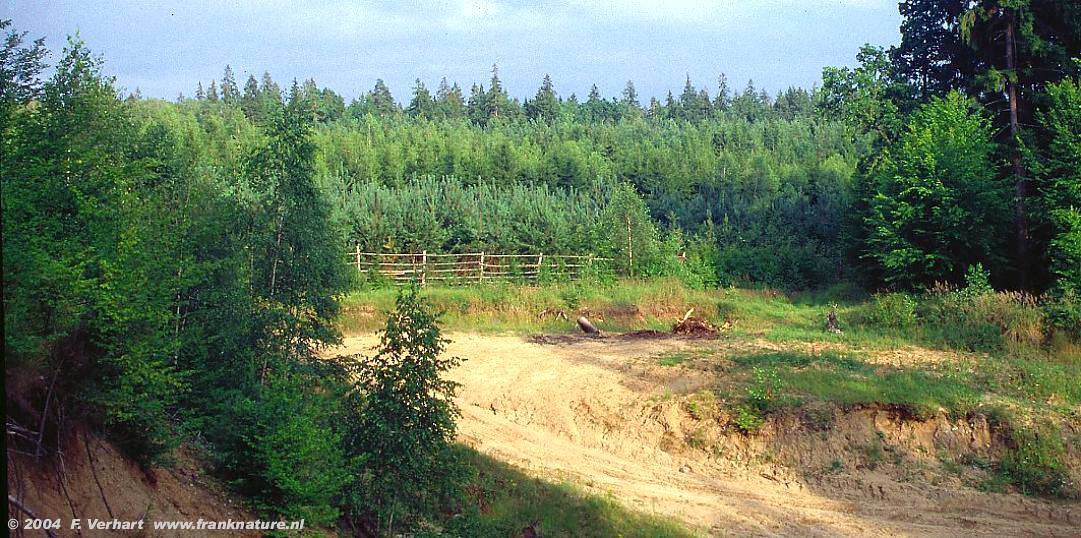 |
28. Extraction of sand for construction purposes locally is a problem for conservation of the unique Bialowieza Forest, while the background shows a tradition of felling adjacent forest stands (Promotional Forest Complex)
.numerous small scaled clear fellings near (in?) the Starzyna reserve (partially "Century Company stands"), heavy damage to forest floor, ploughing the forest.
29  |
30  |
29. At one spot one may see up to three small scaled fellings at a time is sector 696 / 697.
30. This way 20% of the forest cover may actually be in "deforested" state. Fellings of 2003 / 2004.
31  |
32  |
31 and 32. Sector 696 / 697 have the character of "Century Company stands", using ploughs (furrows!) to reshape felled stands is a brutal practice to these areas of natural secondary succession which Bialowieza Forest started 80 years ago!
33  |
34  |
33. Replacing natural stands does not match an ecologically sustainable vision, it is in line with pro-silva management
34. Damage to forest floor made by heavy tractors. Under these wet conditions this will influence the soil for decades, quite possible more than one hundred years (Promotional Forest Complex, sector 513, along recreational trail)
.clear cutting, a practice of recent decades and occasional outbreaks of Bark beetle serve aggressive felling of Spruce in the managed part of Bialowieza.
35  |
36  |
37  |
35. Isolated, small "Old Growth" > 150 years according to the map. In truth a 5 year old Pine plantation (sector 673)
36. Large clear felling with young coniferous plantation (Bialowieza Promotional Forest, sector 666)
37. Planted broad leaved forest about 5 years (Bialowieza Promotional Forest, Starzyna reserve, sector 699)
38  |
39  |
40  |
38. Stump of > 100 year old Spruce. Such felling strictly forbidden before July 10, 2003 (sector 700)
39. Large group felling of old Spruces in order to "fight" Bark beetle (and log valuable wood)
40. Forestry in progress: the sound of White backed woodpecker has been gradually replaced by that of chainsaw, tractor, harvester, wood lorries and cars during the 20th Century (sector 700)
.logs and clearings: do we need to explain why the decision made by the Polish government (1999) not to enlarge Bialowieza National Park to cover the entire forest cannot be understood.
41  |
42  |
41. Huge depot of felled logs - the destruction of Bialowieza Forest
42. Trailers full of primeval logs are removed from the forest clearing on a daily bases
43  |
44  |
43 and 44. "Fighting" Bark beetle by removing its home, Spruces. Bark beetles justify felling of old and natural components of Bialowieza relic primeval forest (Promotional Forest Complex)
45  |
46  |
45 and 46. The "natural composition" of Bialowieza Promotional Forest Complex: a road, a wooden fence and degenerated forest stands of primary origin