
Bialowieza stands rooted in history
By Nathan Johnson, website "The Regional Environmental Center for Central and Eastern Europe", October 07, 2009
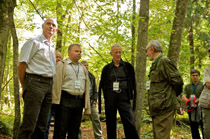
AMONG THE TREES: Delegates enjoy a rest
during a stroll beneath the Bielowieza forest
canopy. Photos: Courtesy of the Polish
Ministry for the Environment
Conference celebrates centuries of forest protection, pushes for park expansion
On the 600th anniversary of Bialowieza Forest protection, various environmental ministers, environmentalists and other delegates gathered Bialowieza, Poland on September 11-12 for an international scientific conference. During the two-day event, Maciej Nowicki, Poland's Environment Minister expressed hope for the enlargement of Bialowieski National Park, which lies in north-eastern Poland and is one of Europe's oldest national parks.
The main objective of the conference was to raise awareness of the natural, cultural, social, economic values and international significance of the Bialowieza Forest, while also enumerating current threats to the forest and its wildlife inhabitants. The conference provided a unique opportunity to discuss bilateral protection efforts over previous centuries by Poland and Belarus, and to point out the universal significance of wildlife habitats for modern civilisation.
"The forest has accompanied us since the dawn of humankind," Nowicki said in his opening address to conference participants. "In Europe, an unbroken strip of great virgin forests stretched from the Atlantic to the Russian lowlands. One-thousand years ago, forests covered 90 percent of the territory of Poland. A lot has changed since then."
After the conference got underway, delegates participated in thematic sessions on education, the importance of primeval forests for forest management policy, social mobilisation of local inhabitants, and protected-area-friendly development. Much of the study material was based on various studies and research institutes dealing specifically with the Bialowieza Forest.
Also during the conference, Minister Nowicki outlined actions connected with the Bialowieza Development Programme, the aim of which is to implement comprehensive development projects on the territory of those municipalities within park boundaries should the park be - if all goes according to plan - tripled in size.
A plea for enlargement
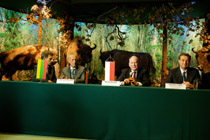
NATURAL SETTING: Nowiecki speaks at the
conference, flanked by fellow environment
ministers Kazlauskas (left) and Calko.
Today the park area covers approximately 10,000 hectares. Calling it a "shame" that only part ofr the Bialowieza Forest has national park status, Nowicki pledged at the conference to "change this." The amount of wood now obtained form the forest from cutting - between 130,000 and 140,000 cubic metres - will be slashed to 30,000 cubic metres when the park is enlarged, according to the environment minister.
The commemoration of six centuries of Bialowieza Forest protection provided an opportune moment to sign bilateral documents aimed at strengthening Polish-Lithuanian and Polish-Belarusian cooperative bonds in the area of environmental protection, and Ministers of Environment Vladimir Calko (Belarus) and Gediminas Kazlauskas (Lithuania) were on hand to do so, as did the other delegates.
The Bialowieza Appeal, which was read to delegates prior to being submitted for signature, contains the following text: "We, the participants of the conference convened on the occasion of the 600th anniversary of the protection of Bialowieza Forest, gathered in Bialowieza; mindful of its everlasting values which represent the heritage of the entire mankind; aware that wildlife knows no political borders, does not belong to any country or any generation and that its beauty is timeless; [...] recognise as the overriding objective the preservation of all variable forms of forests [...] which determine the continuity of the Forest in space and time."
Environment Minister Nowicki then made a final argument on behalf of park enlargement. "I would like to stress that the natural values of the Bialowieza Forest are a national treasure, and it is a responsibility for all of us to protect them for future generations and future centuries," he said. "Therefore, I cherish a hope that the forest municipalities will give their assent to the threefold enlargement of the territory of the National Park, which will be of benefit to us all, and above all to this amazing wild, primeval nature that has managed to survive here."
Honouring the past, preparing for the future
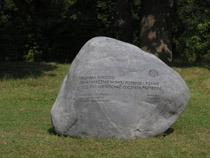
DEEPER MEANING: Words etched into
granite signify future commitment to
forest health and preservation.
The conference closed in front of Bialowieza National Park Headquarters with the unveiling of a commemorative four-tonne granite rock engraved with the following inscription: "Thou Primeval Forest, may Thou last Eternally in Thy Might and Beauty, and Teach Us How to Love the Nature of Our Homeland."
The conference was organised by the Polish Ministry of the Environment. The list of invitees included representatives of UNESCO, the UNFF (United Nations Forum on Forests), European Environment Agency, and the Regional Environment Center for Central and Eastern Europe. Also in attendance were local administration authorities, scientists, non-governmental organisations and members of the media.
Alan Weisman, American professor and author of The World without Us, was invited as a special guest and delivered a lecture entitled 'My Bialowieza Forest'. Several events were held parallel to the conference, including an exhibition of works by A. Strumillo and sculptures by Slawomir Smyk. The Partnership for Climate established its 'small town' exhibit near park headquarters, where inhabitants could exchange more than three tonnes of e-waste for energy-saving light bulbs, while participants took part in an 'action painting' depicting bison in the forest.
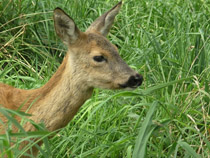
HAPPY HOME: Park expansion will most
certainly encourage greater wildlife
biodiversity
Bialowieski National Park is the oldest national park in Poland, dating back to 1921. It is the only nature site in Poland included in the World Heritage List. The park covers one-sixth of the forest area on the Polish side of the border. The forest's total area is 150,000 hectares, comprising 62,600 hectares in Poland and 87,500 hectares in Belarus.
The 600th anniversary of Bialowieski Forest conservation refers to the events described in the chronicles of Jan Dlugosz which confirm that the forest was the property of Polish kings as early as 1409.
The Polish Ministry for Environment contributed to this article.
Write Your opinion / comment / idea to the Website's Forum