
Three myths about Belovezhskaya Pushcha
Dmitri Korsak, "Sobesednik" (The Interlocutor) newspaper, No 39, September 25, 2009

On October 3 Belovezhskaya Pushcha celebrates the 600th anniversary of the establishing of the strict reserve status. An interdepartmental committee responsible for preparation of the anniversary's celebration has been created on the instructions of the President. During the year the village of Kamenyuki, the administrative center of the national park, has been changed literally beyond recognition. Everything - from roads and sidewalks to roofs - has been renovated. A new building of nature museum with the surface area twice as much has been built. A comfortable hotel has been recently opened. A restaurant and zoo enclosures have been completely reconstructed. All this magnificence came to dozens million of dollars from the state budget.
Both Belarusians and foreigners have a clear and complete idea of Belovezhskaya Pushcha in their heads. It is formed from newspaper articles, videos, personal memories of the older generation which at least once visited one of the country's main natural treasures. Following this idea, Belovezhskaya Pushcha is a large area of the unique relic forest where oaks of 500 years old neighbor with pines and spruces of 300 years and big bison are walking among them. The nature seems virgin. Scientists monitor this magnificence as they got a great opportunity to observe its ecosystem, being out of damage by the civilization. Belarusian Father Frost, whose winter residence is located right there, adds some patriarchal character to the forest.
"There are no problems in Belovezhskaya Pushcha. There are some issues that are under control and management", Nikolai Bambiza, director general of the National Park, said to journalists during the final press-conference.
We decided to visit the jubilee and find out how much the image created matches the reality.
Myth 1: A virgin forest
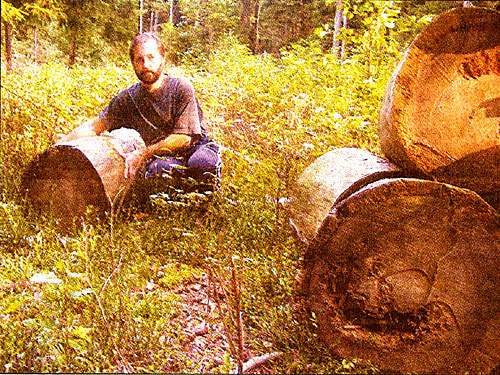
"Unfortunately, only 30% of the image created in the consciousness of the world community is true," Heorhi Kazulka, ecologist, PhD in Biology and resident of the Kamenyuki village, tells. "The first myth is about the virgin local nature. Belovezhskaya Pushcha is divided into four functional zones - Wilderness Protection, Regulated Nature, Regulated Recreational Use and Economic Activity Zone. Only the Wilderness Protection zone is maintained as strictly protected. It covers 30 thousand hectares. Cuttings down and other economic activities including hunting are eternally carried out in the other areas.
One should understand a very important thing - "National Park" and "Belovezhskaya Pushcha" are two different notions. Today these two notions are equal for mass media that is incorrect. For example, it is said that the territory of Belovezhskaya Pushcha takes 167 thousand hectares. But actually the protected area on the Belarusian side has always been and now is 87 thousand hectares. At the same time, the territory of the National Park has been extended double for the last ten years as it happened due to the joining the adjacent areas of former forest enterprises and collective farms. These areas certainly do not have so much value as the very Pushcha.
In 2004 the strictly protected zone was enlarged from 15 to 30 thousand hectares, which means only 30 from historically 87 thousand hectares have the status of absolutely reserved but only for the last 5 years. Moreover, till 1991 the territory of the national park had been the State Protected Game Hunting Ground where only 5 hectares were under strict reservation! Today you will hardly find in Pushcha a quarter where an axe knock or a gun shot haven’t been heart for the last 100 years. Of course, there are the sites which can be considered relevantly virgin and close to the shape of the primeval forest. They are located mostly in wetlands where wood-cutters can hardly get. According to Heorhi Kazulka, the overall historical area of the primeval forest needs to be given a status of strictly protected, so our grand children could be proud of Belovezhskaya Pushcha in its true primeval shape. It will take at least 300 years to make the ecosystem again if this area primeval.
Myth 2: A balance between science and self-financing
"Today the national park's management tries to keep a balance between business, science and protection. These things are hardly to be combined especially in such the valuable area," Heorhi Kazulka believes.
We need to think what is the criterion to define this balance? By the highest standards our main task is to save Belovezhskaya Pushcha for our descendents. In this case any economic activity can cause some damage to Pushcha. For example, tourism is the most harmless economic activity for protected nature. But even in this case we cannot say that it doesn’t do any harm. A Father Frost residence which is annually visited by thousands of tourists is located in the very heart of the protected forest. All of them come on buses there by emitting a big amount of the exhaust gas. This gas contains heavy metals which are accumulated in the forest along the road. Of course, the ecologic situation is not improved by this.
"Is there a balance between nature protection and business in that case?" Heorhi Kazulka asks. "For example we are told "The number of animals got a significant increase in comparison with it in the wild nature". An average man would think "But it is good!" In reality in most cases the animals are bred so intensively and in a big amount for hunting. They are numerous and, suffering from the deficit of natural food, they eat all young tree vegetation and upset the ecological balance.
Belovezhskaya Pushcha has a status of national park and biosphere reserve and is inscribed on a UNESCO's List of World Mankind Heritage Sites. There is a specific conception of its creation and development. "But what happens today in Pushcha doesn’t meet any conception as everything goes its own way there," the ecologist believes. The idea is that the national park is a nature protection institution which main functions are to save and protect the natural complex, and to develop tourism, science and ecological education. In our case it turns out that the economic activities, very often harmful for nature, are basically the main task in the territory of the Biosphere Reserve.
"It is absolutely beyond any logic!", Heorhi says. National park and woodworking are two contradictory things. National park as a guarantee of the human attitude to nature, on the one hand, and commercial hunting there, on the other hand, make an absurd situation! National park and agriculture totally conflict with each other. In certain cases such the activities are possible, but other organizations, not the national park, should managed them in order to prevent conflict of interests. Otherwise, it is strange that the national park must protect forest but at the same time its deep interest is to supply timber as big volumes as possible to a saw-mill. Moreover, we have examples in the world if the area of a national park turns into a tourism zone, then other economic activity come into conflict (with) comes at odds with it. You cannot cut down forest and bring tourists to show them the stubs. That's a concrete example. In the Czech National Park Shumava whit nature protection priorities, all saw-mills have been closed when tourism started to develop in the area. And there was no fuss about it because everybody understood that it was a normal tendency. However, in Belovezhskaya Pushcha, a large timber mill is working right on the territory of the administrative center of the national park.
Myth 3: Everything will be fine
As a result it turns out that in Belovezhskaya Pushcha a terrible conflict between what the administration proclaims, shows and advertises, so all in all creates the image and what is doing in reality and destroys this image last already for many years. Belovezhskaya Pushcha as a primeval and wild forest is disappearing, degrading and transforming into something different, less valuable and significant. According to some residents of the Kamenyuki village who seem to be deeply interested in the development of the social infrastructure in the area, by now the national park looks more like a symbiosis of an entertainment park and a tourist centre.
"The national park holds a monopoly on almost all kinds of businesses on the large territory," a local resident continues. "Let's take for instance the administrative center - the village of Kamenyuki. 5 of 6 shops are the national park's property and only 1 is the private one. There are about 50 shops in the neighbor Belovezha village, which is the administrative center of the Polish Bialowieza Forest, and if I am not mistaken all of them are owned as the private property. Polish managers are not interested in trade. They follow their direct obligations - to protect and research the nature. In our national park, the museum's former building turned into a grand restaurant.
My other interlocutor, the pensioner Vadim Sinyak, who worked as a chief engineer of the State Protected Game Hunting Ground "Belovezhskaya Pushcha" for many years, also marked striking changes that have happened recently.
"I visited Belovezhskaya Pushcha for the first time in childhood, in 1935 and 1936, when it was under polish rule," Vadim Sinyak relocates. Then Pushcha was considered as something magnificent and sacred. I remember well until now how it got easy breathing after we came to the forest. Now Pushcha is being destroyed. And there are a lot of reasons for it - "the epidemic" of bark beetles contributes to it and land-reclamation conducted under previous directors negatively affects. I dealt with timber harvesting - fighting bark beetles we cut down only sick, dying trees. Every tree was inspected by a forester and marked. Today, as far as I know, trees are being cut down in the style near to be clear cuttings. Objectively, there is almost no forest left untouched in Pushcha. They have always been cut down. Mass deforestation was conducted here under Polish rule when Polish managers signed a treaty with Englishmen and built a narrow-gauge railway for timber exporting. German managers indiscriminately cut the forest during the World War I. And during the Soviet time the Pushcha forest wasn’t treated better. Today this "tradition" is kept.
I was participating in building of a woodworking factory in Kamenyuki. But we were building it in order to process only that amount of wood planned by foresters as the sanitary cutting. Today there is a saw mill here which can process the timber much more. Why do they need these volumes? Is it to cut Pushcha? In due time we annually extracted 60 thousand cubic meters of wood while today this number equals 200 thousand cubic meters. We tried to provide the economy in the way that to serve the local people with work at the saw mill, whereas today workers form all over Belarus are brought to Kamenyuki, and fired local people need to work in the district town of Kamenets, regional city of Brest and other places…
Yuri Grechanik, former head of the national park's guard service, has also a negative attitude towards the changes in Belovezhskaya Pushcha.
"First they should have built not restaurants but passages for the animals which already exist at many Belarusian highways nut only appearing in the local area. Look how many snakes and small animals perish on the road! The residence of Father Frost is a former nursery for bison. I remember well that there were fined for a ride on bike through this place during the Soviet time. Now there are a dozen of buses every day there. In general, the Father Frost Residence in such the sacred place is a sacrilege, a murder of the very spirit of Pushcha. Today it cannot be called the natural reserve. It is likely a park of culture and recreation - so called place of entertainment…
… The renovated administrative center really makes an impression - the monument style is worthy of the anniversary. Smooth roads, cut grass on the roadsides, walls of the houses painted bright and nice modern street lamps - everything tells about the piece and wealth of the Pushcha's residents and tourists which come here for the rest. Old Germen are sitting on a bench near a new hotel, they are hunters, and are talking in low voice. They are screwing up their eyes at sun and are definitely looking blessed…
However, despite of all this magnificence I cannot understand why I feel worried. Soon I understand the reason - I, coming to Kamenyuki, realize that Pushcha is losing its wild charm. In comparison with excellent new buildings and a huge entrance gate in the Roman style, the magnificence of the forest is somehow paling, being in the background. It turns out that I am not the only person who thinks so. Saying goodbye, Vadim Sinyak, the 83 year old local resident, tells:
"I am old enough and I have dedicated most of my years to the Reserve. Now before the death I think that all the profits gaining from Pushcha don’t justifies the extraction, processing and trade of its values. Pushcha need to be isolated from all kinds of commerce and be a subject only to the science. The forest is to be given to natural processes." It should be pointed out that these are the words of the man who all his life dealt with the economic activity in Belovezhskaya Pushcha.
Dmitri Korsak
Officially

Nikolai Bambiza, director general of the State Protection Establishment "The National Park "Belovezhskaya Pushcha":
"As a result of measures taken in the National Park "Belovezhskaya Pushcha", we managed to improve it significantly in comparison with its state 7 - 10 years ago. European experts learned the work experience on specially protected natural territories of the Republic of Belarus. On request of the Council of Europe, Poland will soon announce all the territory of the Bialowieza Forest (located on the Polish side, editor's notice) to cover with the national park's status. Only 10 thousand hectares out of 62 make the area of the national park for today. The model developed by the Belarusian side is taken as a base of conservation and development of the Polish park.
As early as 25-30 years ago, the Committee on Environment Protection and the Academy of Sciences have estimated the optimum quantity of all big animals' species for Belovezhskaya Pushcha. Unfortunately, this problem cannot be managed in the easily way because, for example, deer is a quite clever animal which is able to avoid a gun or a loop. However, for the past 3 - 5 years we have taken a complex of measures in Belovezhskaya Pushcha to catch deer and distribute them in other hunting lands of the country.
International scientific conferences have been the main environmental measure for the last years, and a management plan for the national park has become the most important one. This is the complex document about the scientific and economic activities. Both the world community and our scientists demanded its creation during over 10 years. By the way, there have been no similar documents on the territory of CIS.
Write Your opinion / comment / idea to the Website's Forum