
Timeless tune of Belovezhskaya Pushcha
Nickolai LITVINOV, Alena DOVZHENOK, "Zvyazda" (The Star) newspaper, No 244, December 14, 2005
A unique natural complex still remains at the centre of attraction of tourists and scientists all over the world.
Historical roots
In ancient times a space around Belovezhskaya Pushcha turned to a boundless sea during the spring flood. The woodland as an island was above the water and animals found a refuge there to get protected against the "big water". The richness of Pushcha's fauna attracted the hunters. Presence of a waterway from the Baltic Sea to the Black Sea (it still called "from Varangians to Greeks") and the plenty of animals and silicon created good conditions for human life, and the people settled along the rivers. Ancient burial places remind of these times now. Some of them belong to the period of the Melograd culture (VII — III centuries BC). The first references of woods covered the modern Belovezhskaya Pushcha's area are possible to find at the "father of the history" Herodotus (485 — 425 BC), and at Plinius (23 — 79 AD) and Tacitus (55 — 120 AD). The famous Ipatievskaya chronicles of 983 also indicate this area. The Kiev chroniclers mention about the tribes of yatviagi which engaged in hunting and fishing. These militant people repeatedly attacked neighboring lands.
Vladimir Monomah lived long and hunted bison, aurochs and deer in the Pushchs'a area in ХII century. In 1276 Prince Vladimir Volynskiy constructed the city-fortress Kamenetz there. Many people connect an origin of the name Belovezhskaya Pushcha with the Belaya Vezha (White Tower) which was constructed in this city. There are also other versions. For example, settlements were called "vesi", whereas settlements of our ancestors had the appellation "vesi of white people" or "white vesi". Maybe, this word collocation got transformation into "white vezhi" a bit later to originate the legendary name of Belovezhskaya Pushcha. As to the word collocation "Belovezhskaya Pushcha", its first references appeared in Polish and Lithuanian official documents of 1409 and ever since this name became in the permanent use.
The book "Belovezhskaya Pushcha" by Kartsev narrows about the history which is rich of events. This true bookseller rarity takes place of honor on a table of Nickolai Bambiza, general director of the National Park "Belovezhskaya Pushcha". Nickolai Nikolaevich is interested in studying the past of this land. Kartsev writes the following "Data on since Pushcha became a protected area come back to the earlier ХV century". Thus, this time is possible to consider the so-called original start point.
In 1413 Belovezhskaya Pushcha became a Polish possession. Beside of fauna, other natural resources of this land began to be used at that time too. For instance, when King Sigizmund August reigned, production of charcoal and iron was organized, and tar-works were started. In the late ХVI century timber logging began. An inventory of royal woods made in 1639 put the overall objective to examine the conditions in Pushcha and possibilities for its more active exploitation. On the other hand, in 1558 a law on protection of royal hunting grounds was issued, while in 1577 guardianship of bison population began. A number of animals for catching and a rank of people authorized to hunt were set by a special order. In addition, 277 families of foresters to provide huntings and wood protection were settled there.
In 1795 Belovezhskaya Pushcha became a part of the Russian empire. Empress Catherine II permitted huntings of all kinds within its area, with the exception of shooting bison. The quantity of animals was strongly reduced, while bears and beavers became extinct at all. Catherine II, and then Pavel gave away Pushcha's lands to their favorites and retinue that did significant damage to Pushcha (large-scale cuttings down of wood have been conducted). Alexander II banned bison hunting. Active works to restore a red deer population were done at that time. In 1888 Belovezhskaya Pushcha became a property of the tsar family in exchange for grounds in Oryol and Simbirsk guberniyas (provinces).
During World War I the territory of Pushcha was occupied by Germans. Germans cut much valuable timber extracted it from old-age woods. There were constructed 4 plants to process the timber and 300 kilometers of narrow-gauge railways were laid to remove timber out. During the period of two years, 4.5 million cubic metres of timber were delivered to Germany. After the end of the war Poland possessed Pushcha. The Forestry "Reservat" under full protection was created. The remainder of the Pushcha's territory was under strong exploitation of natural resources. For instance, a British company called "Century European Corporation" harvested wood. However, a concession contract was cancelled a bit later, whereas large areas of old-age woods were already cleared.
In 1939 Pushcha was incorporated into the Byelorussian SSR and announced a State Nature Reserve. During the Second World War, this territory almost not suffered because Gering initiated decision to create an exemplary hunting ground there for top-officers and persons of the Reich. In 1944, after banishing German-fascist invaders from this territory, an intergovernmental Soviet-Polish meeting was held in Moscow. According to an agreement signed there, Pushcha was divided into the Belarusian and Polish parts along the state line.
The Nature Reserve, which was reorganized into a State Protected Game Ground in August 1957, continued its operation within our territory. Nikita Khrushchev was an initiator of this transformation. Belovezhskaya Pushcha became a place to provide hunting serves for the top-officials of the Communist Party and leaders of the socialist countries. A complex "Viskuli" with a guest pavilion, hotel, cottages, sauna and refrigerator premise to store killed game was constructed. The fast increase of ungulate stock began that was an unwarrantable step as too numerous ungulates destroy the environment. However there also was some positive matter connected with creation of the Game Ground for nomenclature elite. Conditions of life were greatly improved – high-quality roads appeared and cordons were equipped by electric and telephone services. Comfortable houses for the Game Ground's employees, and also a school, polyclinic, House of Culture, Museum of Nature and some other objects were built. Plots under protection were designed in Pushcha and scientific researches began to be carried our. By a decision of the Council of Ministers of the Republic of Belarus on September 16, 1991, the State Protected Game Ground was reorganized and a State National Park "Belovezhskaya Pushcha" was created, the first in our country. Its territory has been divided into functional zones. This enabled to apply both passive and active methods of protection of plants and animals' populations. On 27th September of the last year, the head of the country issued a decree and ratified a Regulation on the National Park "Belovezhskaya Pushcha". According to it, the Park is defined an "especially protected territory of the national importance. Its area is managed in order to create conditions for protection, natural development and integrated study of the typical and unique natural complexes and objects of the Belovezhskaya Pushcha Primeval Forest and biological and landscape diversity within the area, to restore the broken natural complexes and objects of a special ecological, historical, cultural and aesthetic value, and also to sustainable use for nature protection, scientific, educational, health-improving, recreational and other purposes". So we have that significance and importance of the National Park "Belovezhskaya Pushcha" is underlined at the highest state level. The authorities always paid much attention to the unique natural complex and this brings results — the National Park "Belovezhskaya Pushcha" is dynamically developing and surely has a great future.
"Traditions need to be saved", Nickolai Bambiza considered. "The history of Pushcha is extremely interesting. However, it is impossible only to go in the cycle of the rich and interesting past. It is necessary to work for prospects, do not stop the achievements."
New pages of the modern history of Belovezhskaya Pushcha are created. They are not less interesting and scaled than the previous ones. They have some features which are specific only for our time. However, all is to tell in succession.
A scientific laboratory
The extent of the National Park from north to south is 60 kilometers and from west to east is from 10 to 50 kilometers. Its area is 163,500 hectares (for comparison, the Bialowieza National Park created on the Polish side of Pushcha covers nearly 10,000 kilometers). Belovezhskaya Pushcha is a very specific region concerning flora. A geographical location, climatic, soil and hydrological conditions caused richness and diversity of vegetation. There are about 60 percents (nearly 1000 species) of vascular plants of the country within this relatively small territory. The same concerns to proportion of mosses or bryophyta (about 270 species) and lichens (over 290 species).
Belovezhskaya Pushcha is a unique natural site with all of varieties of Belarusian woods both regarding species composition, age structure, productivity and biological associations. Almost 90 percents of the territory of Pushcha makes a "green zone" where artificial plantations make only about 10 percents. UNESCO ranks Belovezhskaya Pushcha by biological richness and biodiversity conservation level with such worldwide famous woods as the Amazon valley and Gabon tropical rain forests. A patch of the European nearly intact primeval woods with the extremely rich natural complex of flora and fauna has been saved there. The average age of woods of Belovezhskaya Pushcha is over 100 years old. The maximal age is from 200 to 300 years old, while there are some individual trees of from 300 to 600 years old. An oak-patriarch tree is the example. Its age makes nearly 600 years old. This oak is over 28 meters high and 2 meters in diameter. One more old-timer, a pine-giant tree, grows nearby the oak tree. It is more than 30 meters high and more than 350 years old.
"The woods of Belovezhskaya Pushcha makes so-called filter (biogeochemical barrier) which blocks transfer of industrial trans-boundary air pollution from the countries of Western Europe — basically of Silesia and Bavaria", deputy general director of the National Park "Belovezhskaya Pushcha" Eugeniy Busco said. These are the areas where largest industrial complexes are concentrated. The transfer goes to our side because of prevailing winds of the appropriate direction. In 1992 - 1996 a special study of these processes was carried out. According to it, all the territory of Belovezhskaya Pushcha was divided into 5 zones with different levels of industrial pollutions. The same research was carried out this year. Its results testify the quantity of emissions which are considerably less now. It is well.
Moss and grass bogs cover over 3,000 hectares in Belovezhskaya Pushcha. As regulators of gas composition of the atmosphere and hydrological situation, they are very important to maintain stability of ecosystems and preserve biodiversity of plants and animals. Fauna of Belovezhskaya Pushcha comprises over 10,000 species. Mammals are diverse. They consist of 59 species that makes 85 percents of fauna of Belarus. There could be more species, however some species became extinct. So, aurochs was annihilated in ХVII century, and then wolverine disappeared. In ХVIII century beaver, red deer and tarpan (wild house) became extinct, in ХIХ century — bear, wild cat and flying squirrel, in the earlier XX century — bison and after 1953 marsh-otter does not exist in this area. There was a period when wolves disappeared in Pushcha.
There were many attempts to restore the species composition of Belovezhskaya Pushcha and even to enhance it. A red deer, bison and beavers were successfully acclimatized or reacclimatized, as well as a fallow deer which was annihilated during the First World War. The cases to acclimatize a reindeer and a moufflon and to reacclimatize a bear were unsuccessful. By the way, the last did not visit Belovezhskaya Pushcha over 20 years. In 2002 the bear was a guest in the Pruzhany district during a shot period, it even wintered, but then it left these places. One can see a tarpan-like horse, which ancestor were wild tarpans, in show-enclosures of the National Park. Some species found an ecological niche in Belovezhskaya Pushcha migrated from other areas. They were a raccoon dog, musk-rat and mink. Rodents are numerous there. They consist of 20 species. Among them a beaver is the most attractive. Among Pushcha's predators one can see a wolf, fox, lynx, martin and among large ungulates — wild boar, red deer, roe deer and moose.
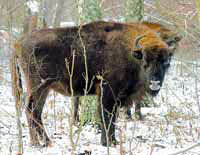
Bison is a species which requires a separate story. This species is the largest in Europe and one of the most ancient animals all over the world. Bison appeared at the same time as a mammoth. This species became near complete extinction. In 1919 the last she-bison was killed. There was no one free living in the natural environment animal while some of them were saved in zoos and zoo-gardens in Western Europe. To change the situation and avoid complete extinction of this species, an International association on bison rescue was created in 1923. Thanks to inventory, there was revealed that the only 52 specimens remained all over the world at the end of 1924. Belovezhskaya Pushcha which belonged to Poland at that time was selected the priority to make bison restoration works. In 1939 19 animals were totaled in a special nursery which was created in Pushcha. The first five bison were bought from Poland and delivered to the Belarusian part of Pushcha in 1946. Their free-living breeding began since 1953.
Their quantity gradually increased over the time. On time of 1990 the largest in the world herd consisted of 315 animals was created in the Belarusian part of Belovezhskaya Pushcha. But it turned out that such the quantity considerably outnumbered an optimum level recommended for an appropriate area. Therefore works on regulation of the density of animals and their settling in other Belarusian regions began. 299 bison live in Belovezhskaya Pushcha now. Nearly 600 animals are totaled all over our country. Eugeniy Busco noted that at present this topic is discussed with the Polish party to create special migration corridors for bison in order to enable the animals move through a barrier. They are not able to do it now because a prickly wire is present at the border. It is possible that the diplomats will shortly find a conciliatory decision of this problem and bison will be able freely to walk across the overall territory of Belovezhskaya Pushcha because of the indissoluble blood bond between them. During our business trip, we heard such the formulation "Pushcha was saved because bison populated it, while bison was saved because Pushcha existed". This is short, clear and deep. There is nothing to add.
"This species is a true adornment of woodlands", Nickolai Bambiza said. "Bison comes to Pushcha because it cannot survive without human assistance. Bison is a true owner of Belovezhskaya Pushcha, beauty and pride of the wood. This truth should be unforgettable.
We had the luck to meet the free-living owner of Belovezhskaya Pushcha when we went from the place with the oak-patriarch tree to the pine-giant tree. A small herd of bison crossed a road. Impressions were inexpressible. Animals have slowly gone deep into the forest while we have come back to continue our businesses.
It is impossible to describe all beauty, colour and enigma of the local nature in short. Belovezhskaya Pushcha, after the fussy and noisy capital, looks like completely another space — the world of silence and harmony where heart and soul get relaxation. You can comprehend all greatness and riches of this corner of the motherland Belarus.
"This is really a unique scientific laboratory to study biological diversity", Eugeniy Busco is sure. It comprises all variety of plants, animals and microorganisms which world-wide distribution is characterized by figures of from 5 to 30 millions species. Belovezhskaya Pushcha, because of its official status of Biosphere Reserve, is mainly to protect species populated wood ecosystems. 18 employees including professors and philosophy doctors are an staff of our scientific department. There are two sectors. One of them deals with bison and other wild ungulate animals, while the second provide forest investigations. There are also experts on ornithology. Their major duty is to study birds of wetlands and bogs, eagles and capercaillies. The department of geo-information systems was recently established. We have close cooperation in this field with the National Academy of Sciences (there is an appropriate industrial association in the Institute of Cybernetics there), the Belarusian State University and the Technological University. We restored partnership relations with the Sank-Petersburg Institute of Botany, the Moscow State University, the Ural Botanical Garden, the Institute of Medicinal Plants of Russia, the Timiryazev's Agricultural Academy and a number of scientific institutions of Ukraine and Baltic countries. We also closely cooperate with the Polish colleagues, and with the scientists of other countries.
This contributes to solving numerous tasks on perspective development of the unique natural complex of Belovezhskaya Pushcha in an integrated way.
How to attract a tourist?
This is clear because it is very important to save interesting objects attributed as sights of Belarus, for the sake of children and grandchild, for the sake of the future. But how to do it? An obvious way is to do it through the development of a domestic tourist product. Tourism is one of the most effective businesses the world over now. This field makes 36 percents of service trade and 10 percents of world export. The cultural and ecological tourism wins an advantage over the "beach" one for more and more people. The tendency of development of this branch is extremely favorable for our country. It is impossible to waste such opportunities. There are interesting things and places to look at have rest in our country.
Belovezhskaya Pushcha is surely one of these places. One who visited it at least once will dream again to come back there. Pushcha is notable for some original magic and attraction. We can say with confidence about it because we were back there after a rather long period (we came last time there in childhood, however the memory reliably kept that trip) and it was very pleasant to visit Belovezha even in such the long interim. A great deal of things changed here. Moreover, news of the last time are extremely positive.
I think, it is necessary to tell about the Tsar Road in more detail. The road was open by Emperor Nickolai II and his wife Alexandra Fedorovna in 1903. The road connected towns of Pruzhany and Hajnowka and was considered the war-strategic since the western border of Russian Empire passed at that time there. Catherine II was the first who suggested an idea of such the construction. However, as we witness, this project scaled for those times was realized much later. The road was made very well that is confirmed by many experts. Small bridges which were erected along the route are the example of this statement. Their rails were saved in an excellent condition till now because a nearly "eternal" material, oak water-seasoned wood, was used to make them. Cast iron railings are at bridges where two-head eagles and special metal balls (they, as a matter of fact, serve as road marks as showed entrance and departure directions) were attached. The eagles and balls were cut off after the October Revolution. However, today all is already restored. Very little works are necessary to complete and the Tsar Road will become the place of honour among the tourist routes of the National Park "Belovezhskaya Pushcha".
Indeed, there are very many things possible to see in this unique corner of Belarus. Burial mounds, where the first inhabitants of Pushcha – yatviagi were buried, are shown to have good conservation up to now. The same concerns to boulders of cultural importance (these huge stones were brought by a glacier from far Scandinavia in due time), revered by this ancient tribe. The former country estate of the Svisloch Forestry Enterprise owned by General and Senator of Poland Tadeush Tyschkevich changed almost nothing in the external shape. The visitors have an opportunity both to examine this distinctive and interesting building complex and live in the "szlachta" house look like to find themselves in those far times. It is pleasant to have rest avoiding the watching "traditional" TV and sitting near a wonderful fireplace with a glass of warm tea in a hand or to play a game in billiards. In short, one can be sure that you will remember such the trip for a long time.
However, this it is far from all what can provoke a tourist to get interest in Belovezhskaya Pushcha. Fans of olden times are desirably to drive on a road constructed in the period of the last Polish King Stanislav Ponyatowski, and also to visit a picturesque glade where charcoal and tar have been produced at one time. The inquisitive people will be surprised to see huge wild-honey trees which were used by the wild-honey farmers to extract honey of wild bees. The visitors of Belovezhskaya Pushcha perceive a feeding-trough-construction for bison, which was made in 1907 (one of the poles has a date of its manufacturing cut out by the builders), as a symbol of indissoluble connection between generations.
The National Park has great opportunities for development of ecological tourism. A Museum of Nature is its true pride. This is rightfully one of the most visited cultural and educational institutions in our country. A richest collection of animals inhabited Belovezhskaya Pushcha has been completed there. A part of them are listed both in the Belarusian and International Red Books. One can see various species of animals in their environment which are placed in large open-air enclosures nearby the Museum of Nature. As a rule, the present owner of Belovezhskaya Pushcha (bison) is the major attraction for the visitors. If to have the luck, it is possible to see the giant in its wild environment during a very interesting travel over the reserve. Various categories of the visitors can choose pedestrian, horse and car tourist routes lasting one or several days, according to their wish. Believe me, there is a scope for your imagination here. One will hardly refuse such the tempting offer to wander in the immense space of the legendary Belovezhskaya Pushcha.
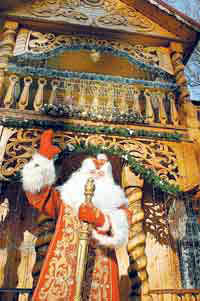
Visit the National Park without fail on the eve of the New Year's and Christmas holidays, when the adults and children want to believe a fairy tale and wish to get magic. A true estate of Grandfather Frost appeared in Belarus a few time ago. This unique tourist object was constructed under an order of the head of the country. Such the approach completely justified itself. Two wooden knights - Dub-Dubovich, the Oak-knight, and Vyaz-Vyazovich, the Elm-knight – meet the visitors at an entrance of the territory of the estate. It is said that these knights are the brothers of the Belarusian fairytale personages - Dub-Dubovich, the Oak-knight, and Gora-Gorovik, the Mountain-knight. Earlier they grew in the shape of huge trees in Belovezhskaya Pushcha and the Grandfather Frost liked very much to talk kindly to them during walk in a wood. Time passed and trees are dead. The Grandfather felt pity for the friends and he asked a Gold-Hands Master, one of the most famous in Belarus woodcarvers Alexander Maslo, to make figures of two guard-knights. Due to this they appeared near the gate to guard the peace of the Grandfather Frost.
He lives the year round there. The Belarusian Grandfather Frost has a costume adapted to each season. The estate is known as the really unique one. There are only three estates all over the world similar to the Belarusian one - in Lapland which is the native land of Santa Clause, in Alaska and Belovezhskaya Pushcha. They are wonderful. The Grandfather Frost's estate is currently full of people. Tourist groups replace one another as all of them like to meet the owner of the snow and frozen winter. The Grandfather Frost meets all the visitors by appearing on a balcony. We, the reporters of the "Star" newspaper, were struck off the rule — the Grandfather leaved the house to meet us at a veranda. I can say this feeling is wonderful to stand close to the hero of children's dreams (including yours as well, but of many years ago) and to talk about magic. There are no doubts of real existence of the Grandfathers Frost since it is possible to touch him. You begin to believe in the fairy tale here, especially on the eve of the Christmas's celebration when all the most of unbelievable desires should come true.
"Grandfather, what kind of the next year is going to be?" we asked the Frost.
"The next year will be kindest and brightest. All our dreams will come true without fail. We are the hard-working people and, therefore, all will be OK", we heard the answer.
"Will the New Year's day be deep in snow?"
"Snow, my dear, should be after all. I think so. But if there will be no snow (you know the weather lately has the abrupt character), I shall go up the stairs to the first floor of the house, shall open doors and shall begin to shake out a feather-bed. Snow will appear and all of us will be good and cheerful..."
Now the estate is full of people. The Grandfather Frost has much work. Besides of greetings to the numerous visitors, he should investigate the correspondence. Over 50,000 letters have been addressed to the estate before time we arrived (the earlier December). About 1,000 letters is delivered per day. Children, certainly, write in different ways and appeal to the Grandfather Frost with different requests and wishes. Letters are very kind and sincere in most cases. For example, this is one of the typical. "Grandfather Frost, I need nothing. Make that no one of children was ill and all people all over the world did not suffer from heavy diseases. Grandfather, make me to be a doctor when I will grow up that I could cure all of the people. If I deserve it, send me your photo..."
There are a lot of most different miracles in the estate of the Belarusian Grandfather Frost. For example, it is a mill. There is a popular belief that if a man will touch it and will list all his sins the mill will grind them. The next basic sight of any New Year's holiday is a Christmas tree. The beauty-tree in Belovezhskaya Pushcha is higher even than a famous Christmas tree on Trafalgar square in London. The tree recently lighted tens thousand small fires...
Huntings are a separate topic for discussion.
"Tradition to hunt in Belovezhskaya Pushcha was created over the centuries, Nickolai Bambiza emphasized."And they were saved. The tourists see it and, therefore, there is a great demand. The people all over the world come to us for hunting. For instance, a tourist from Morocco was recently there.
It is necessary that everyone was very clear - regulation of the quantity of wild ungulates is under permanent conduction. Selective elimination and catching to resettle the animals is provided in order to improve the population and create good conditions for natural regeneration of the wood. Accordingly, the hunting tourism is also carried out. There is an appropriate infrastructure. The experts on hunting are skillful to serve the tourists-hunters. The conditions for the fans of fishing are improved. There are about ten artificial reservoirs within the territory of Belovezhskaya Pushcha. Each lake got a special passport and appropriate fish-management substantiation. We supple lakes with fish. Accounts (still the theoretical) are now conducted to introduce a sturgeon in lakes of Belovezhskaya Pushcha."
This is good "bait" for the tourists. Certainly, all of attractions, we told about, really raise the image of Belovezhskaya Pushcha in the eyes of the numerous visitors. It is possible even to say that the tourist product created in Belovezhskaya Pushcha is the unique one, not only because of the richness of the facts but rather owing to skill and big desire to inform the visitors about all beauty and originality of Pushcha. Impressions got by the tourists after visiting Belovezhskaya Pushcha can probably be characterized in sort as admiration. The steady growth of amount of the arriving tourists testifies this statement. Nickolai Bambiza informed that 46,000 people visited Pushcha in 2001, while already over 140,000 visitors came this year. Do you feel the difference? This "break-through" became possible thanks, first of all, to systematic and careful work, active propagation of features of the National Park and its nature, and improvement of tourist service.
By the way, it is about service. Comfortable hotels with modern comfortable rooms are ready to service the tourists. It is also possible to accommodate in special guest houses. One can enjoy in a restaurant "Belovezhskaya Pushcha" by eating national dishes with fish and game meat. There is a perfect sport complex in the National Park which includes a tennis court and area to play handball, volleyball and mini-football. The visitors can be served with billiards, sauna, bath-house, equipped guest glades and tourist parking.
Works on improvement of services in the National Park "Belovezhskaya Pushcha" are in full swing. Nickolai Bambiza informed that the nearest plans are to construct one more modern hotel with 50 rooms. According to Nickolai Nikolaevich, the conditions should be created to enable the people who arrived to Belovezhskaya Pushcha to have rest both for body and heart. Reconstruction of a road network is in progress. To cover these needs, the National Park was allocated about 2 millions dollars from the state budget. Technical re-equipment of the Park is also in progress.
"It is paid much attention to development of the National Park "Belovezhskaya Pushcha", Nickolai Bambiza emphasized. "It is possible even to say that this is one of the state priorities. All critical problems appeared are operatively solved in an appropriate way. Financing is at a level sufficient to serve nature protection activities. Such means are bigger even than in the Soviet times. I can surely confirm it. All is necessary to put in good order here. We improve and we shall further improve objects of social sphere. Trade service in built-up areas in Pushcha is already maintained in a proper way. Service to deliver children in the Kamenyuki secondary school has been organized. This educational institution has the ecological specialization. Our successors are educated there.
Thus, we see that the National Park "Belovezhskaya Pushcha" has great progress and properly goes ahead in the future. This place is at the centre of attraction of the scientists and tourists all over the world. According to Nickolai Bambiza, there are all reasons solemnly to celebrate 600-years birthday of nature protection on the European continent in 2009 (such the date is specified in archive sources). It is logically to celebrate this historical event in Belovezhskaya Pushcha. Inhabitants of far countries become familiar with Belarus in many respects thanks to Belovezhskaya Pushcha. Thus, Belovezhskaya Pushcha is our true national symbol. The most important is, perhaps, to save this unique site for our children and grandchild in order to enable our descendents to hear the timeless tune of Belovezhskaya Pushcha too...
Nickolai LITVINOV, Alena DOVZHENOK
Maria ZHILINSKAYA (photo).
---------------
(The newspaper "Star" is the state edition in Belarus. This leads to extremely "major" tone of this publication and avoiding negative facts and evidences.
The reference by the editor of the Website "BP 21 Century")