
Votes for and against Belovezhskaya Pushcha
Sergei KLIMENKO,
The Environmental Public Initiative "Pro Wild Nature", Brest city;
Specially for the website "Belovezhskaya Pushcha - XXI century", January 19, 2005
or what kind of future chose inhabitants of Belovezhskaya Pushcha
The Belovezhskaya Pushcha's countryside
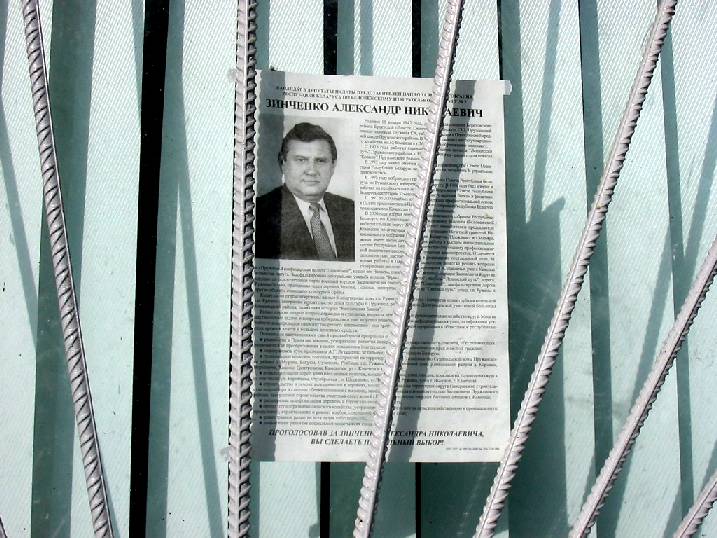
Authorities' candidate under
"iron" protection
Ten years ago sociologists raised the alarm about aging population in the area which had up to 40% of retirees and, on the whole, a low level of education - more than 50% of the population, mainly people of forty and over, have only elementary education at best, about five percent have higher education, ten percent have vocational training. In a nutshell, education and culture seem to be rare things in the area.
However, there are still some patches of "civilization" there. One of them is the village of Kamenyuki, the administrative centre of the National Park "Belovezhskaya Pushcha". It is not quite a village, rather a small urban-like community with population of about 1,500 people. A small residential area, commonly known as Damanski, was built in Kamenyuki in the 1970s and 80s. This area has several dozens of two- or three-storey buildings with comfortable flats (just like in a big town) as well as several cottages. The administration of the national park used to take care of its workers. The economic situation was also favourable for that. Kamenyuki stood out from the rest of locally found "collective farm" villages in many aspects, and the fact attracted to it quite a number of specialists. It is no wonder that the new administrative workers, who came to the National Park "Belovezhskaya Pushcha" from the Pripyatski National Park a few years ago, were sorry to find out that "here they have so many people with high education, people who can stick to their point of view and speak out about their rights!"
Comparing to those who live in the Pripyat area, the people in Kamenyuki are indeed more educated, free-minded and independent. Their close ties with neighboring Poland have made them more aware of good Western values.
Got is near
Yet there is more important distinction about Kamenyuki and its people. The area of Belovezhskaya Pushcha is under direct president's control, which means that all powers of regional and local executive committees, as well as of various ministries in the area are virtually in the hands of the President's Property Management Department. Over the past ten years the thing has led to formation of a kind of state-within-state system there. It is said that about five years ago one of the national park's directors was even reprimanded for allowing into the area of the national park. the head of the executive committee of the Brest region!
Belovezhskaya Pushcha has always been a "possession" of the mighty of this world - at one time in the history it was governed by princes, tsars, communist party officials. Today, the Belarusian president rules there. The mere nearness to the people of high rank and position has always been a factor in the conduct of behavior of people working in Belovezhskaya Pushcha. Directors of the national park were more like local princes, rather than other Soviet-era authorities while their powers were determined by the relations with top state officials who liked to use the park as their own. That is the explanation why the future and well-being of the "princes" depended but little on common workers of the park. That is also the reason why so many of these people have always been, mildly speaking, disappointed with the "princes".
The latest history
For the locals the modern history of the National Park "Belovezhskaya Pushcha" is divided in two: the pre-Bambiza period before the spring 2001 and the Bambiza period itself after the spring 2001. In their names the periods not dubiously refer to incumbent director of the national park Nikolai Bambiza as, they say, it is with his appointment that Belovezhskaya Pushcha has been taken over by a group of people whose actions often violate the Belarusian law. By the way, the key person behind the group, former head of the President's Property Management Department Galina Zhuravkova, is now under arrest and is prosecuted in connection with abuse of her powers and embezzlement of millions of dollars. The only fact is enough to see the scale of the group's criminal activity. It is since Mr Bambiza's appointment that local people have been maltreated and the unique primeval forest of Belovezhskaya Pushcha has in many ways lost its beauty and wilderness. Outspoken insults of local people by the new national park administration have become all in the days work. The obligatory system of contract employment on humiliating terms has ultimately taken from the people their rights and made the majority of them be like "cogs in the machine". Hundreds of the people lost their jobs in the national park in favour of outside temporary workers who, following their arrival from mainly the Polesie region, have considerably raised the level of crime in Kamenyuki.
There were some attempts of protest against the new discriminating policy of authorities. At the outset there were letters to newspapers and complaints to influential government bodies and state institutions, but neither were properly considered and so neither could help. On the contrary, those who stood up for protection of the people and the national park suffered the most while the bulk of the people gradually abased losing all hope for the better future. The people got used to the new conditions, but with their hope also lost all faith in the authorities, both local and state. The people became outwardly subdued, but kept their indignation with the authorities deep inside. The people became cautious expressing their thoughts, but did not become slaves.
Direct president's control over Belovezhskaya Pushcha undoubtedly affects the administration of the national park as well as all local officials, and one cannot say in the circumstances that they "disobey" the decisions of the head of the country. Even the retirees can see through the current situation and understand whose will Mr Bambiza executes and whose patronage he uses. The result of all this is that Kamenyuki has grown anti-presidential among other intimidated villages in the area.
The most important day
Such was the general mood of the local people before the last important historical events - the presidential referendum and the parliamentary election of October of 2004. Although a month before the election the state machine launched massive brainwashing of the public trough TV, radio and press, of course there could not be any radical shift in the people's opinion. Keeping that in mind, the local authorities employed their administrative power telling the people to vote ahead of the scheduled day. With such intimidations as termination of a job contract, denial of a holiday or a bonus payment, the workers of the research department of the National Park "Belovezhskaya Pushcha" were ordered to cast their ballots on the first day of the prescheduled public vote, turning the whole procedure into a kind of circus game. Those at the saw mill in the village had a shorter working day to be able to vote ahead, the retirees were asked, just like the teachers of the local school were "advised" to vote the same way. As for the postal workers, they had to report on the results of such voting several days ahead of the general public vote. Naturally, the people were scared to vote on the official day of the election as they were scared to lose their job "in connection with the expiration of the job contract" or, in the case of the retired, be left without help about their farmsteads. However, the feeling of fear definitely could not make the people like the authorities.
Consequently, there were about 740, or 62%, out of total 1200 people who could vote in the village voted ahead of the official voting day. This is an astonishing figure! This is the election with almost a 100% turnout! The voters' activity is surprising and frightening at the same time. Well, besides a feeling of intimidation and conscientiousness, there was a mobile ballot-box which was delivered to old and sick people in remote villages.
Searching the truth
The referendum results were predictable, yet surprising for the people in Kamenyuki - it turned out that about 84% of them, that is over 1000 people cast the vote "for" the president and his proposal to change the Belarusian constitution, and only about 14%, or 170 ballots, leaving aside the spoiled ones, were "against". Tremendous support!
If one looks at the parliamentary election results, there were two candidates from opposition - deputy of the head of the Belarusian Socio Democratic party Anatoly Levkovich and representative of the "5+" opposition coalition Elena Dovguchits - they had almost 50% of votes. And there was Zinchenko Aleksandr, who represented the state authority and in the upshot became a delegate to the parliament.
So the people in Kamenyuki were not different from any other people in the country voting "for Belarus", as they were asked, advised or taught in the state media. The people chose a "radiant, happy and peaceful" future.
Many of them have doubts about it, however, as it appears then that 30% out of almost 50% of the people, who voted for candidates from opposition, at the same time voted for the alteration of the constitution; that is for continuation and support of the current policy of the government and the president. It could hardly be that they voted "for" and "against" their intimidation, persecution and restriction of their rights contradicting themselves. The contradiction must have been simply caused by those who made the people vote ahead of the official voting day, as there is no guarantee that all ballot-boxes are guarded safely at night by the state representatives who take interest in the election and referendum results.